Faculty Spotlight: Paul Dayton, PhD
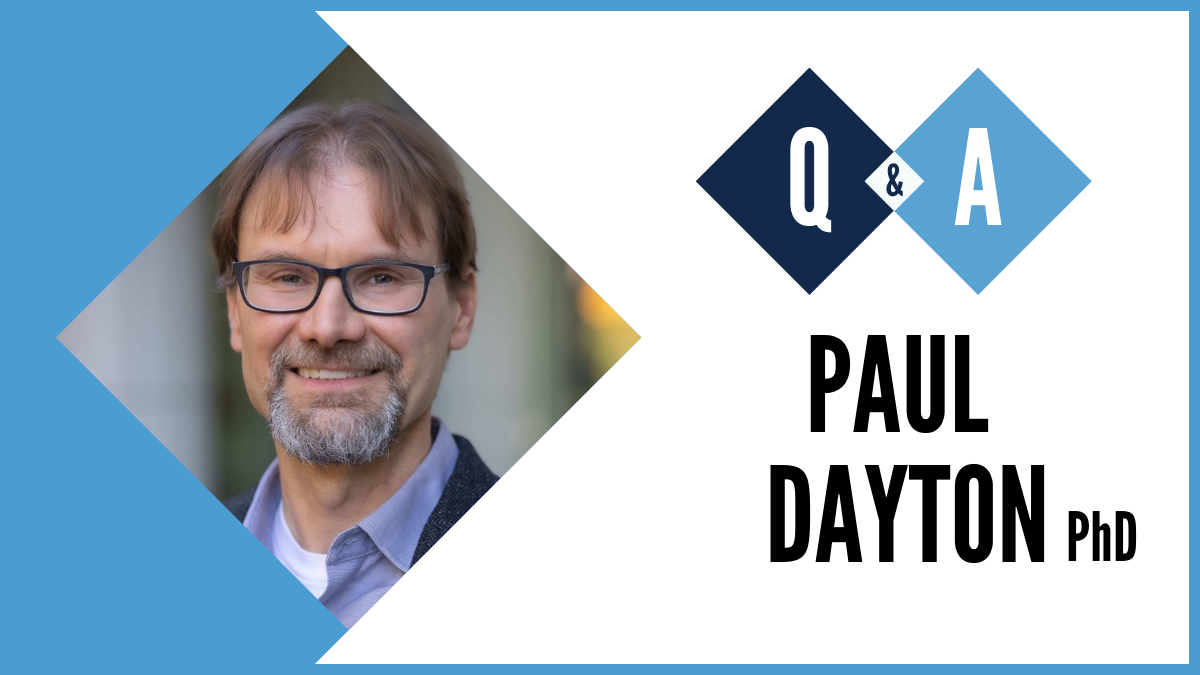
Paul Dayton, PhD, the William R. Kenan Jr. Distinguished Professor and chair of the Lampe Joint Department of Biomedical Engineering, has helped transition several innovations in ultrasound technology from the academic lab to the commercial space. His efforts have led to four startup companies—SonoVol (acquired by PerkinElmer in 2022), Triangle Biotechnology, Nanosonic Bioreagents, and Sonotherapeutics—each translating fundamental discoveries about ultrasound-microbubble interactions into commercial applications spanning cancer therapy, drug delivery and laboratory diagnostics. An IEEE Fellow and National Academy of Inventors Senior Member, Dr. Dayton exemplifies the translational researcher who bridges academic discovery and entrepreneurial impact. In this interview with KickStart Venture Services, he shares how early observations of oscillating microbubbles sparked a career-defining pursuit, and how UNC-Chapel Hill’s innovation ecosystem has helped him build multiple ventures while advancing ultrasound-mediated therapeutics.
Your early training under Dr. Katherine Ferrara involved high-speed optical and acoustical analysis of individual microbubbles. What was it about watching these microscopic bubbles oscillate and interact with ultrasound that convinced you this technology could revolutionize cancer imaging and therapy?
Well, interestingly, I never intended to work with microbubbles. In college at Villanova as a physics and pre-med major, I was excited about medical imaging. I worked in a chemistry lab doing nuclear magnetic resonance (NMR) after classes as well as in a physics lab doing surface science with vacuum chambers. I decided to go to graduate school to learn about Magnetic Resonance Imaging (MRI) because I thought the ability to see inside the body non-invasively was amazing. When I arrived at the University of Virginia to work under Dr. James R. Brookeman using a highly innovative hyperpolarized gas imaging system, the MRI system wasn’t working yet. So, I joined the lab of Katherine Ferrara, a new UVA faculty member who was an expert in in ultrasound color-flow imaging and was just starting her lab at Virginia. I spent the first year of my PhD studies learning about ultrasound from scratch, ordering equipment and generally making things work. At the time, in the mid 1990’s, ultrasound contrast agents, which are basically microbubbles, were brand new on the clinical scene. There was very little data about how they worked, how they behaved in the body or in an acoustic field, or how to optimize ultrasound systems for their performance. Since they are very small, they were also not easy to observe. I had fun designing new experimental tools, usually combinations of microscopes, ultrasound systems, and high-speed cameras, to study microbubbles in an acoustic field.
Since it was a novel field, my early work was received with intense enthusiasm. During my first conference presentation as a young graduate student, I showed videos on a 19-inch, “1990s style” tube TV at the front of a conference room. The videos showed microbubbles moving around in what looked like crazy antics in acoustic field due to what is known as radiation force. The whole room got up and crowded around the TV. After that, I was hooked. I spent the next five years of my PhD exploring microbubbles and their applications, while developing bigger and better tools each year to do so with better temporal and spatial resolution. My initial interests were just in the basic physics studies of the science. But as I became more senior in my studies, I (and others) realized that microbubbles could be used as unique tools to advance ultrasound imaging and therapeutics beyond anything possible at the time.
You’ve co-founded several startups, beginning with your first company SonoVol (acquired by PerkinElmer in 2022). How did you get started, and what did you learn from your early startup experiences?
Well, in some sense, I was just lucky. SonoVol was our first venture, with the concept developed in the lab by Ryan Gessner, one of my first PhD students when I was a new faculty member in Carolina’s biomedical engineering department. Our lab was developing ultrasound techniques to look at disease markers, and we worked with people from the Lineberger Comprehensive Cancer Center and other UNC departments that had mice and rats with different diseases they wanted to study. Ryan and I quickly learned that the ultrasound tools available then weren’t ideal for working with small rodents. They were hard to use repeatedly and consistently and had limited fields of view.
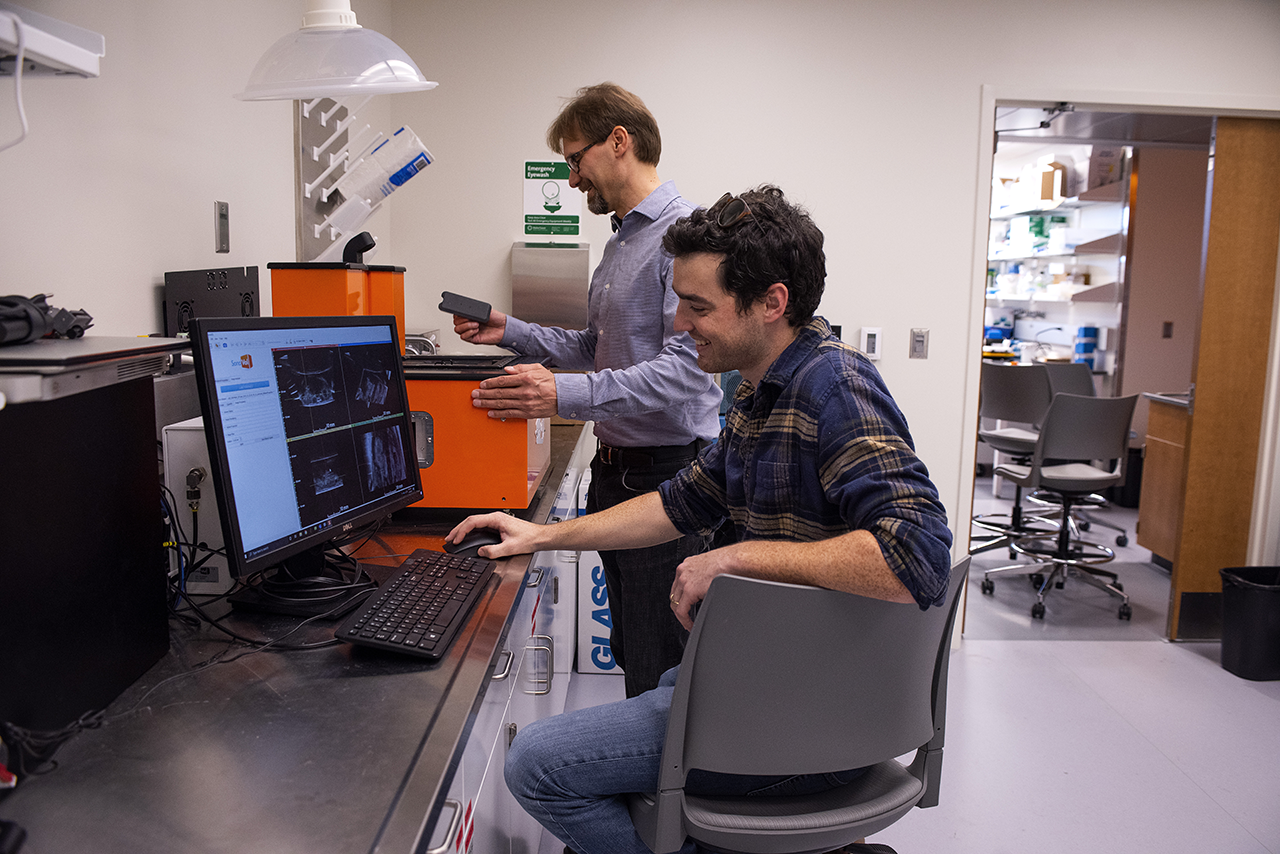
We had the idea that maybe we could make an equivalent of a Xerox machine for animals. You put the animal on a platform, and then the system moves the ultrasound transducer across the animal to image the whole animal in a controlled and repeatable way. We jokingly referred to it as the Easy-Bake Oven for animal imaging. The idea was to remove the need for an experienced person to hand-hold the transducer, increase repeatability, and make it possible to reconstruct ultrasound data (which was almost all 2D at the time) into a 3D volume. As a bonus, we developed new technology for microvascular imaging based on designing transducers with more than one frequency element. We had the foresight to file patents on both technologies. I think this was largely because in my PhD lab, Kathy Ferrara encouraged patent filing.
Early on, we hadn’t thought hard about whether our vision of the device was ready to spin out, but the KickStart Fellowship and I-Corps helped us dig deeper to see if our idea could be a real product. Those helped us refine our idea into something practical and marketable.
The NSF STTR Phase 1 grant was the critical mechanism that provided the company with initial funds to build a prototype. Most importantly, since the company initially didn’t have any space, we negotiated a facilities use agreement that allowed SonoVol to rent space in my lab at the University. This helped the fledgling company build its initial prototype and use some of the University’s equipment. We were one of the first companies to do this at Carolina, and it took a long time to get everything approved. The KickStart team also provided critical expertise with the incorporation and recommended people who could do the company’s accounting, taxes, legal paperwork and payroll. These are things that many scientists don’t know how to do. The company initially existed only the rented University space but eventually moved to the First Flight Venture Center in Research Triangle Park (RTP) after receiving additional SBIR funding. The company grew iteratively and became increasingly independent. Ryan expanded his team with more graduates (eventually more than 15 UNC and NC State grads worked at SonoVol). He became an expert in writing SBIR grants, securing multiple Phase 1 and Phase 2 grants. The company brought on scientific advisors and multiple experienced business people as consultants and board members. The technology got better and better, eventually becoming a polished product: a benchtop 3D robotic veterinary ultrasound system for imaging small animals. Several studies demonstrated that the system was superior in terms of reproducibility and that it showed equivalent performance to much larger, more costly systems such as MRI. Company leaders started attending trade shows, and customers wanted to buy the system.
One thing that really enabled us to carry SonoVol from academic inception to acquisition by PerkinElmer in 2022 was that, as a veterinary product, it didn’t need any major regulatory body approval (i.e. FDA). While we did need electronic device approval (UL listing and CE mark), these requirements were much easier and less costly than medical devices needing FDA approval. As a non-clinical device, there was no need for insurance reimbursement pathways. And having the experienced business team to negotiate the deal with PerkinElmer as critical.
Your second startup, Triangle Biotechnology, took a technology originally designed for medical imaging—microbubbles that vibrate with ultrasound—and transformed it into nanoscale “jackhammers” for DNA extraction in laboratory workflows. How did the pivot from therapeutic to industrial application come about. What does it teach us about staying open to unexpected applications of fundamental research?
The next venture started with an academic collaboration between my biomedical engineering lab and the laboratory of Bill Janzen, who was in the Eshelman School of Pharmacy at the time, and one of Bill’s senior team members Samantha Pattenden, who is now an Associate Professor in the School’s Division of Chemical Biology and Medicinal Chemistry. Bill’s lab needed to fragment DNA, a critical step required prior to sequencing, and they were frustrated with the output from commercial sonicators. Ultrasound is a standard tool for breaking up DNA, but the available tools at that time were either challenging to use in a reproducible manner or extremely expensive, with some systems costing more than $100,000. Existing options were also relatively slow throughput—only a few samples at a time—largely because they required a large amount of acoustic energy delivered to the sample, requiring a high-power ultrasound system for a long period of time. My lab specialized in microbubbles, which can be used for ultrasound contrast agents, but fundamentally these microbubbles act as acoustic amplifiers. The collaboration started with an idea exchange between Jason Streeter (one of my graduate students), Sidd Shenoy (a BME undergraduate) and Chatura Jayakody (a scientist working for the Janzen lab). They came up with the idea to see if microbubbles could enhance DNA shearing in Bill’s lab. The bubbles allowed DNA shearing with lower acoustic delivered pressures, which was a big step forward. But the bubbles didn’t last long mixed in solution, so they still didn’t really fix the problem.
At the same time, in my lab, a different student named Paul Sheeran tried a new process and discovered that we could make an entirely new formulation of contrast agent that was much smaller than the microbubble and remained in a liquid state until it was exposed to ultrasound. This made it neutrally buoyant (unlike bubbles that floated out of solution quickly) and much more stable than a microbubble. We called this the low-boiling-point phase change nanodroplet. We filed a patent of this technology and the formulation methods, which resulted in several patents through divisionals of the original filing.
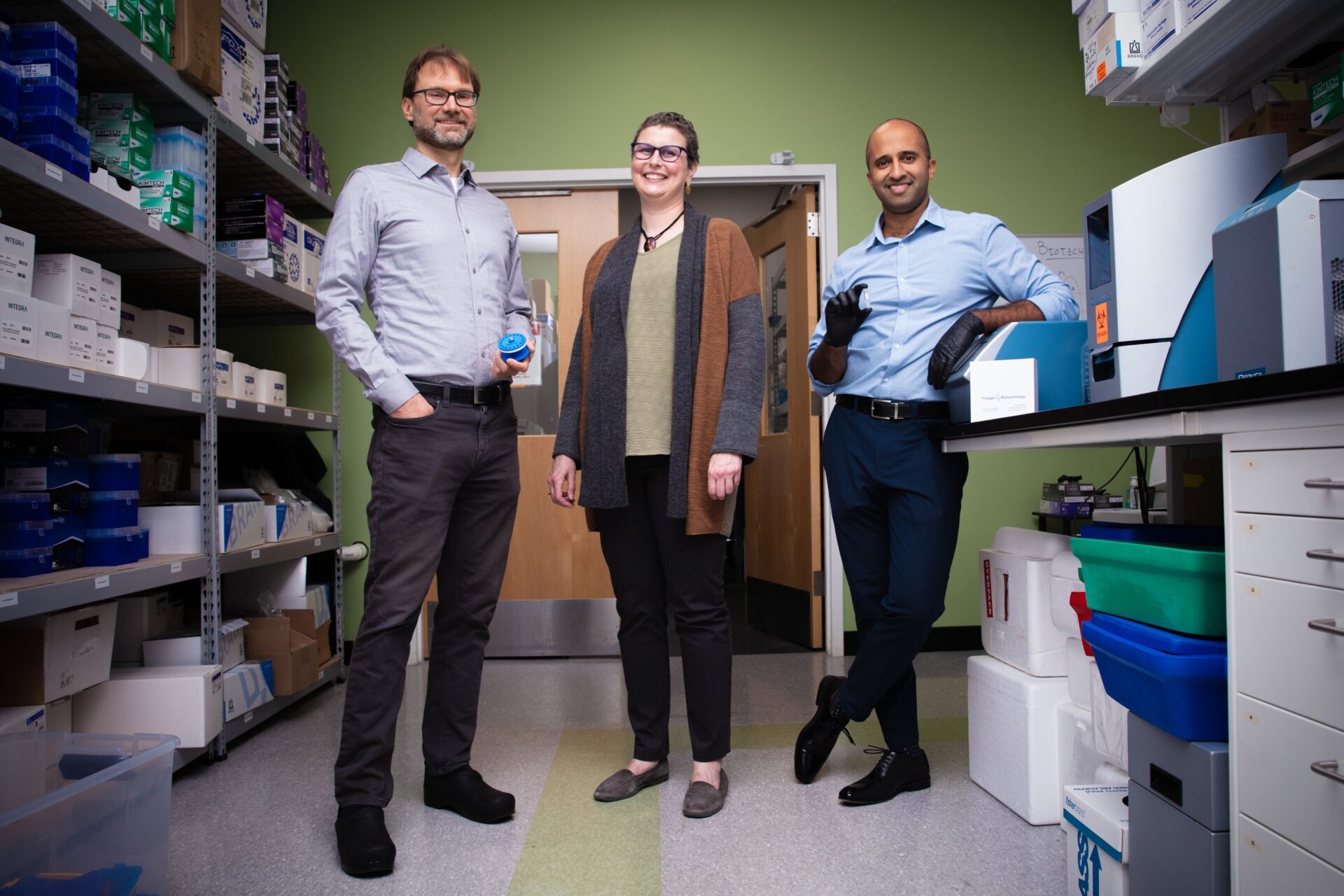
With Jason Streeter graduating, a new studentSunny Kasoji started working with the project using the new nanodroplet formulation that Paul was developing. Sunny worked with Samantha Pattenden from the Janzen lab and discovered that these new nanodroplets worked much better than the bubbles because they didn’t float and stayed in solution to mix with the DNA. They allowed DNA shearing using a low-power desktop jewelry cleaner water bath, something unheard of before. The team published a first paper on the findings. Within a week, our paper had more than 1,000 downloads, and people from industry reached out for more information. One local company, Syngenta in RTP, licensed and purchased a batch of our nanodroplets from the laboratory to use in its workflow. Syngenta was excited about the technology, started incorporating our nanodroplets into some of its sample processing, and bought more supply. Shortly after, a major sequencing company started buying our nanodroplets for its workflow. At this point, we thought we had a commercial idea, so we founded Nanosonic Bioreagents to commercialize the nanodroplets. But with limited experience, we built the founder team with all scientists—and six people, which was too many. We had little focus, no business experience—and we didn’t use the expertise of KickStart. The team also had differing opinions on the direction of the company, with some of the group interested in the DNA shearing and others interested in different applications. After about one year of little progress and no funding, we dissolved the company.
This project became purely an academic collaboration for a few years, and we had strong success bringing in more NIH funding to further develop the nanodroplets and DNA shearing technology. Finally, we decided to try a new venture focused on DNA shearing exclusively. This time, we started immediately partnering with Joe McMahon and Bioventure Partners, a company dedicated to supporting early-stage ventures (Joe was also a board member for SonoVol as that company grew). Triangle Biotechnology was co-founded by Joe, Samantha and me. Like Ryan with SonoVol, Sunny, who was graduating, applied for and received the Kickstart Fellowship. He became the first full-time employee of Triangle Biotechnology. We worked together to submit SBIR grant proposals, and this time, we obtained pivotal funding quickly. The company initially had equipment-use agreements with UNC and incubator space on campus. To stay focused on biological sample processing, it sublicensed various unrelated applications of its technology to other companies. It continued to grow with SBIR funding, Sunny took on the CEO role, and now Triangle Biotechnology has its own space in Durham. Triangle Biotechnology just had a fantastic reception at the Society for Lab Automation and Screening conference in Boston, and is looking forward to their commercial product launch this year.
How are you involved with SonoVascular, a startup whose technology could provide better solutions and outcomes for doctors and patients dealing with blood clots?
I’m not technically a co-founder of SonoVascular in the business sense. SonoVascular came about through my collaborations with Xiaoning Jiang, a professor in mechanical engineering at NC State University and one of my longest collaborators in North Carolina. One of our early grants proposed to make miniaturized transducers optimized for contrast imaging to image characteristics of blood vessels from the inside out. This academic project developed some new transducer technology, and we filed patents. Notably, we were awarded a Chancellor’s Innovation Award at NC State, which is given to technologies with commercial promise. This award and a press release that caught the attention of Dan Estay, an experienced biomedical entrepreneur in the RTP area with experience in medical catheters. Dan toured our labs and learned about the technologies we developed. Xiaoning and I continued to develop new technologies for using catheters to break up blood clots. This caught Dan’s attention, and he and Xiaoning incorporated SonoVascular. At the time, Xiaoning asked if I was interested in joining them, but I had my hands full with SonoVol and Triangle Biotechnology and declined. However, the company proceeded to license its foundational intellectual property (IP) from my lab and Xiaoning’s labs. I came on board as a scientific advisor for SonoVascular and continued to work with the team to write early SBIR grants and develop the technology. SonoVascular is different than SonoVol and Triangle Biotechnology as its technology is clinical, which requires FDA approval and reimbursement. The company leadership model is also quite different. Rather than a slower build that depends on SBIR funds and being led by a scientist with business advisors, SonoVascular moves fast. It is driven by an experienced business leadership team, raising outside funds from investors—without waiting for slow grants. Dan has been very successful, raising critical investor money and building a strong board of experienced business leaders, clinical advisors and engineers. The company had first in-human trials in 2025 and is working toward FDA approval of its catheter device.
You’re now working on a new startup that is developing a technology that could help hospitals solve challenges with chronically infected wounds. What’s on the horizon?
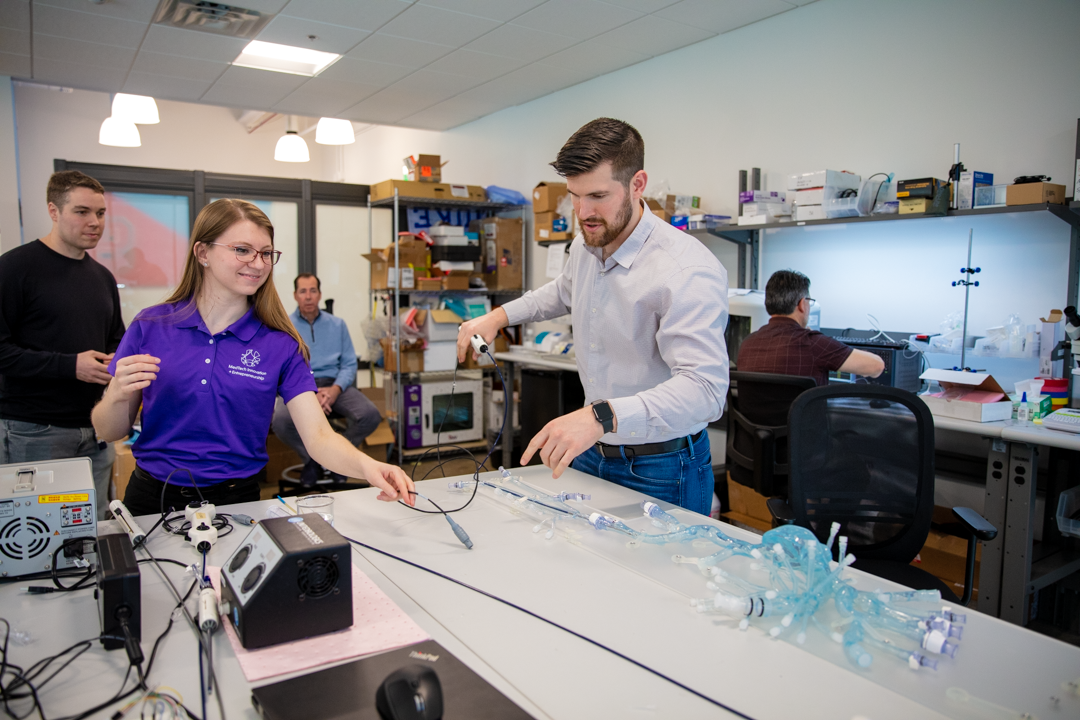
SonoTherapeutics is a very new venture, and we’re still working on its launch. It’s a collaboration between my former postdoc Virginie Papadopoulou (who is now an independent faculty member in the radiology department at the UNC School of Medicine), Sarah Rowe-Conlon and Brian Conlon from the Department of Microbiology and Immunology at UNC, and me. This project, led by Virginie and Sarah, stems from the discovery that we can use ultrasound and the aforementioned nanodroplets to kill bacterial biofilms and sterilize chronically infected wounds with bacteria such as MRSA, which otherwise present major challenges in hospitals. The team has been meeting with scientific advisors and business leaders, while continuing academically funded research on acoustic biofilm treatments to support the IP. Virginie and Sarah have participated in a lot of Innovate Carolina business programs, such as Nucleate, to build our business strategy, and practiced many pitches for customer discovery and feedback. One challenge is that has held us back a bit is the pause in the SBIR program. We’ve submitted grants but have no funding. We want to recruit a full-time company employee, but that requires funds. So, we’re lining up our business and engineering expertise, data, and pilot funding to build our foundation.
What surprised you most about the journey from academic discovery to entrepreneurship?
Perhaps what surprised me most was how little I know about business. There’s so much more to making and getting paid for a product than just the science of making something that’s technologically interesting. Many academic scientists don’t know much about business, sales, marketing, regulatory approval and reimbursement. But there are people who do. Meet them. Talk to them. And work with them.
How do you decide which technologies are ready to spin out?
I think part of that is luck. Part of it is gathered by customer discovery surveys: would people buy it? For non-regulated products, that might be it. Will people buy what you’re selling at the price you can sell it? But, for clinical products, you also need to know if it will be FDA approved. You need to know how it will fit into the clinical workflow. If your technology makes one aspect of treatment better, but it’s difficult to use or doctors don’t like it, it will fail. You also need a whole other process—medical reimbursement—in order to be paid for the technology. Having the right people to help you navigate these challenges is essential.
As chair of the Lampe Joint Department of Biomedical Engineering, how do you encourage faculty, graduate students and postdocs to engage in innovation and entrepreneurship? What strategies have been most important for fostering this culture while maintaining excellence in research and education?
One of my sayings as chair is that in order to make the biggest impact in patients’ lives (which is our dept mission, to unite engineering and medicine to improve lives), we need to translate technologies out of the lab and into the commercial space. We hang patents and stories about companies that spun out of the department on the halls in our building. This keeps our translational mission front and present. Our educational curriculum incorporates aspects of technology innovation and commercialization. We provide students opportunities to interact with business school students, and they are required to take classes in the business school as part of their master’s curriculum. We recognize and support faculty who are interested in starting companies, provided their companies support their academic mission. But we are faculty first. Starting companies not related to our academic mission is considered a distraction, but commercializing IP developed in our labs is in harmony with our mission.
From the KickStart Accelerator to the North Carolina Biotechnology Center’s translational grants, you’ve used numerous UNC and state resources to advance your ventures. For faculty considering entrepreneurship, which early-stage resources were most critical? And how can they successfully navigate the innovation community?
Resources are hard to come by for early-stage companies. I advise people to look everywhere. In the cases of SonoVol and Triangle Biotechnology, we started with University funding from KickStart Venture Services. SonoVol went 10-plus years on only SBIR funds. It was extremely successful in raising non-dilutive funding. Triangle Biotechnology has raised a mix investments but is primarily built on SBIRs also. SonoVascular has been the opposite, largely raising investor funds.
There are always trade-offs: the more non-dilutive funding you raise, the more ownership of the company your employees keep. The more money you raise from investors, the more of your company you trade to investors for their money, and there is less company ownership left over for the employees. For expensive technologies, such as clinical products, you need more money than SBIRs can provide alone. But, when these companies are acquired, their value is usually a lot higher than non-clinical products. A smaller piece of a big sales price can still provide value to the employees.
As for the most valuable funding, the KickStart Fellowships enabled a paycheck for the first dedicated company-focused employee. Then, second, is the SBIR mechanism. SBIRs have been somewhat easy to obtain compared to investor money for early-stage companies, and they provide critical first funding. Let’s hope the SBIR mechanism is renewed. I would also say the North Carolina Biotechnology Center’s Translational Research Grant has provided helpful early-stage support for several of our ventures. Regarding the support community, we benefitted multiple times from the Innovate Carolina network: from its classes and workshops, to its SBIR grant-writing support funds, which have been very helpful, to its pitch classes and feedback from entrepreneurs-in-residence. We’ve gotten many positive comments on the SonoTherapeutics pitch deck, which went through a lot of refinement with support from Innovate Carolina teams.
You’ve received major recognitions, including the IEEE Carl Hellmuth Hertz Ultrasonics Award, election as an IEEE Fellow, and being named a National Academy of Inventors Senior Member. As you look at the trajectory from those early microbubble observations as a trainee to becoming a leader in the field, what challenges in ultrasound-mediated therapeutics still excite you most? And where do you see this technology heading in the next decade?
Ultrasound is unique because it’s perhaps the only imaging tool that is getting smaller, cheaper and more portable—as well as better in image quality. Most medical imaging tools like MRI, CT and PET are huge systems that need dedicated technicians to operate. They cost millions of dollars and have a relatively low throughput. This means that their accessibility to rural North Carolina and other remote parts of the U.S. and the world will always be limited. However, ultrasound systems are based on electronics which are being miniaturized thanks to the cell phone industry. A modern ultrasound system can run off a cell phone and can cost about the same, less than one-thousandth the cost of an MRI system. They can run on battery power and slip in your pocket, making them easily accessible and low cost. Ultrasound today is literally the futuristic “Tricorder” pocket medical diagnostic tool of late 20th century science fiction show Star Trek.
Ultrasound also has another major advantage: beyond imaging, it can also be used for therapy. The result is combination image-guided therapy. While ultrasound therapy is still being developed and isn’t as clinically widespread as ultrasound imaging, it is quickly becoming a new medical tool for non-invasive treatment. UNC now has a dedicated therapeutic ultrasound system that can treat brain pathologies non-invasively by focusing sound beams into the brain, avoiding a surgeon’s scalpel altogether. Microbubbles are a critical part of this formula because they can be used with ultrasound imaging to visualize vascular features not possible with standard ultrasound. They can also enhance ultrasound therapy by enabling local therapeutic effects, while reducing the ultrasound power delivered to the patient, or by carrying therapeutic compounds directly to the site of disease or pathology.
One next advancement that we’ll see in ultrasound will be real-time, large-field of view imaging. Smaller, faster electronics mean that we can use more transducer elements and see larger parts of the body at once. Faster processing will allow us to achieve better resolution through data averaging and other processing techniques. We’re already doing this in the lab, but the clinic technology is about 10 years behind. Another big breakthrough will be new and broad applications for therapeutic ultrasound, including applications in the brain, immunology and cancer. One particularly exciting area is neuromodulation, where we can use ultrasound to modulate brain or neuronal response. One can envision a patient with an undesired neurologic condition: a tremor, chronic pain, seizures, substance abuse addiction, or even depression. Precise delivery of ultrasound to select parts of the brain might allow you to gently nudge the neurologic response in a corrective direction to alleviate these conditions. A miniature wearable ultrasound patch might make this a minimally invasive solution. UNC is uniquely positioned to be one of the leaders in the field of ultrasound applications in neuroscience. I’m excited to see where we will go next.
 | UNC-CH