Zelsuvmi® (berdazimer topical gel) wrapped its first year on the market as the only FDA-approved at-home treatment for molluscum contagiosum in 1-year olds and older, a common viral skin disease predominantly affecting children. The breakthrough took 20 years and a combined effort from a UNC-Chapel Hill chemistry lab, a team of entrepreneurs and biopharmaceutical company Pelthos Therapeutics. Please see Important Safety Information at the end of this article and full Prescribing Information.

The first time Dan Riccio, PhD, worked with nitric oxide, he was a doctoral student at the University of North Carolina at Chapel Hill. He spent his days building milligram-scale batches of an experimental compound in Professor Mark Schoenfisch’s chemistry lab. Two decades later, he stood at home holding that same discovery in his hand, but now it was a prescription medication he had picked up at his local pharmacy.
A few years earlier, when Riccio’s young son developed molluscum contagiosum, a common viral skin infection in children, there was little to do but wait. The itchy lesions lingered for nearly two years before finally clearing, leaving scars behind.
But when his 6-year-old daughter later developed the same infection, the outcome was different. By then, the medication had a name — Zelsuvmi, with the active ingredient berdazimer — and approval from the U.S. Food and Drug Administration (FDA) for the topical treatment of molluscum contagiosum in adults and pediatric patients aged 1 year of age or older. Riccio filled a prescription for the gel that his graduate research helped set in motion decades earlier. Please see Important Safety Information at the end of this article and full Prescribing Information.
Today, Riccio’s connection to Zelsuvmi extends beyond his family. He works for Pelthos Therapeutics, the biopharmaceutical company that launched it commercially in summer 2025 after its FDA approval in January 2024.
Riccio is one of many people at multiple organizations who worked for years to get Zelsuvmi into the hands of patients. Those include researchers in the Schoenfisch lab at Carolina, employees of UNC-affiliated startup Novan, investors, and industry partners at Ligand and Pelthos Therapeutics. Their persistence and determination means patients, parents, and caretakers now have an at-home treatment option for this burdensome skin infection.
Molluscum contagiosum is widespread, infecting about 6 million people in the U.S. annually. The virus spreads easily and mostly infects children younger than 10. It causes clusters of small, raised lesions that itch and can linger for months or even years. Until Zelsuvmi, there was no FDA-approved, at-home medicine to treat it.

The standard advice was to wait it out. “The biggest response used to be to do nothing, and it’ll go away on its own,” said Carri Geer, PhD, who joined the Schoenfisch lab at Carolina as a doctoral student in 2003 and now serves as Chief Technology Officer at Pelthos Therapeutics. “But for a lot of kids, they have molluscum for many months, and sometimes the infection can persist for years.”
Families whose children needed treatment had to visit a doctor’s office, and the remedy wasn’t pleasant. “The options were limited to potentially painful physical destruction methods — either freezing, cutting or burning them off,” Geer said. On a small child, the treatment could be as hard as the disease.
Zelsuvmi gave parents and physicians an option they’d never had for treating molluscum. It is the first and only FDA-approved at-home prescription treatment for the disease, which means families can opt for a topical gel instead of “watch and wait” or potentially painful procedures.
For the scientists involved in the early research, the impact is not abstract. “To hold that in my hand at home, to be able to see something that we made in grad school, and to have it be real here in my medicine cabinet, was special to me,” Riccio said, recalling the first day he treated his daughter. “Treating my daughter,” he said, was the moment when the whole journey made sense.
Long before the FDA approval, the team at Pelthos Therapeutics sensed how badly families wanted the treatment. “Parents would write us letters, desperate to get into clinical trials to give their kid a chance to have access to the medication before it was approved,” Geer said.
The science that would give families a better option began as a conundrum. Nitric oxide is a molecule the body makes naturally. It supports healing, fights microbes and regulates blood pressure — a role significant enough to earn a team of pharmacologists the Nobel Prize in 1998. But it is a gas, which makes it trickier to use as a conventional drug. You can’t easily hold it, dose it or target it to a specific location in the body.
Nitric oxide’s perplexing promise has long intrigued Mark Schoenfisch, PhD, Ornstein Distinguished Professor of Chemistry at UNC-Chapel Hill who holds a joint appointment in the Eshelman School of Pharmacy. Schoenfisch leads a chemistry lab that researches novel ways to use nitric oxide to improve human health.
One central question in his lab was whether you could store large amounts of nitric oxide in a stable, solid material and then release it in a controlled way. “We started to appreciate that high nitric oxide payloads might be beneficial for standalone therapeutics,” Schoenfisch said. “And that ultimately led us down this path of trying to commercialize it, which took a significant amount of effort and funding.”
The therapeutic platform, called Nitricil™, co-invented by Schoenfisch and his graduate students is the foundation for what became Zelsuvmi. But for it to reach patients, they needed to move their invention beyond the University. To do so, Schoenfisch co-founded a startup called Novan in 2006 with Nathan Stasko, PhD, then a doctoral student in his lab.
“When we started the business, I knew we could store more nitric oxide by weight than anyone else in the world, and we could fine-tune the release with better control than prior nitric oxide technologies,” said Stasko. The hard part, he said, was never whether the molecule worked. “Nitric oxide works. It was always a question of if it could be delivered at the right place, at the right time.”
The path from discovery to approved drug took almost 20 years and involved numerous twists and turns. Fresh off graduating with his doctoral degree, Stasko became Novan’s first employee and, at 26, its President. His first order of business was to license the technology from the University.
An early infusion of capital from Neal Hunter — a serial entrepreneur, Cree co-founder and Novan’s first investor — gave the startup a huge shot in the arm. “Neal’s initial funding helped get things off the ground, because we hadn’t even demonstrated proof of concept in animals yet,” said Schoenfisch.“ We subsequently wrote and submitted multiple federal and state grants and contracts, many of which were funded by NIH, NSF, DOD, BARDA, and the state of North Carolina to accelerate development and commercialization efforts.”
Schoenfisch said the company initially considered pursuing nitric oxide as an oncology treatment but pivoted to dermatology as the more feasible path. Still, hurdles emerged. “I knew taking a drug to market was costly and timely, but what you don’t take into account are the necessary and unavoidable setbacks along the way,” he said. “Those add both time and money to the equation.”

Developing the technology as a startup without the resources of a pharmaceutical giant was a challenge. Perhaps the greatest hurdle, Schoenfisch noted, was the novelty of the product itself. It is the first and only drug developed using the UNC-born Nitricil platform to store and release nitric oxide at the skin’s surface.That originality meant Stasko and Schoenfisch had to frequently explain the chemistry and platform — how it worked and what was needed to advance it — to both potential investors and regulators at the FDA that were unfamiliar with the technology.
“The main challenges that Nate and I overcame were the limited stability and shelf life of previous strategies— and then how to manufacture Nitricil at scale,” said Schoenfisch. “We brought together engineers, chemists and pharmaceutical scientists to address the big hurdles that had previously prevented commercialization of nitric oxide-releasing therapeutics.”
After several successful private financings that incrementally raised capital to fund the growing company, Stasko led Novan as CEO to a public listing on the Nasdaq to pursue a pipeline of dermatology programs before molluscum emerged as the lead.
The final push to market came through Ligand, which had backed the technology since its mid-stage clinical trials and saw enough promise to take it the rest of the way. Ligand acquired the technology and assets from Novan in 2023, stewarded the asset and team through FDA approval in January 2024, and then launched Durham-based Pelthos Therapeutics to carry the product, built on the original UNC intellectual property, into the hands of patients. Pelthos just recently celebrated the first year of market sales.
“Commercializing UNC research requires a long-term perspective, and the path rarely follows a straight line. It begins by protecting a promising discovery through intellectual property, followed by years of scientific development, investment and collaboration,” said Chance Rainwater, a commercialization manager in the UNC Office of Technology Commercialization. “Zelsuvmi is a remarkable example of how a sustained commitment can transform research conducted at UNC into an FDA-approved therapy that has the potential to impact patients’ lives. The discoveries being made in UNC laboratories today may take decades to reach patients, but storieslike this demonstrate why universities continue investing in research and commercialization.”
Two of the individuals involved — Geer and Riccio — have worked on the technology at every step, from Schoenfisch’s lab to Novan, Ligand, and now Pelthos. It’s an unusual continuity in an industry where almost no one travels a technology’s full arc from discovery to approval.
“I have tremendous respect for Dan and Carri who stuck with the technology from the first steps with the FDA, investigational new drug (IND) submission, clinical development, new drug application (NDA) approval, and commercialization,” Stasko said. “That is an extreme rarity in the industry.”
For the scientists themselves, the end result traces back to a single choice. “It has been a privilege to have had this experience, from graduate school to real-world application and being involved in all stages of the product,” Geer said. “And it started with choosing Carolina for graduate school.”
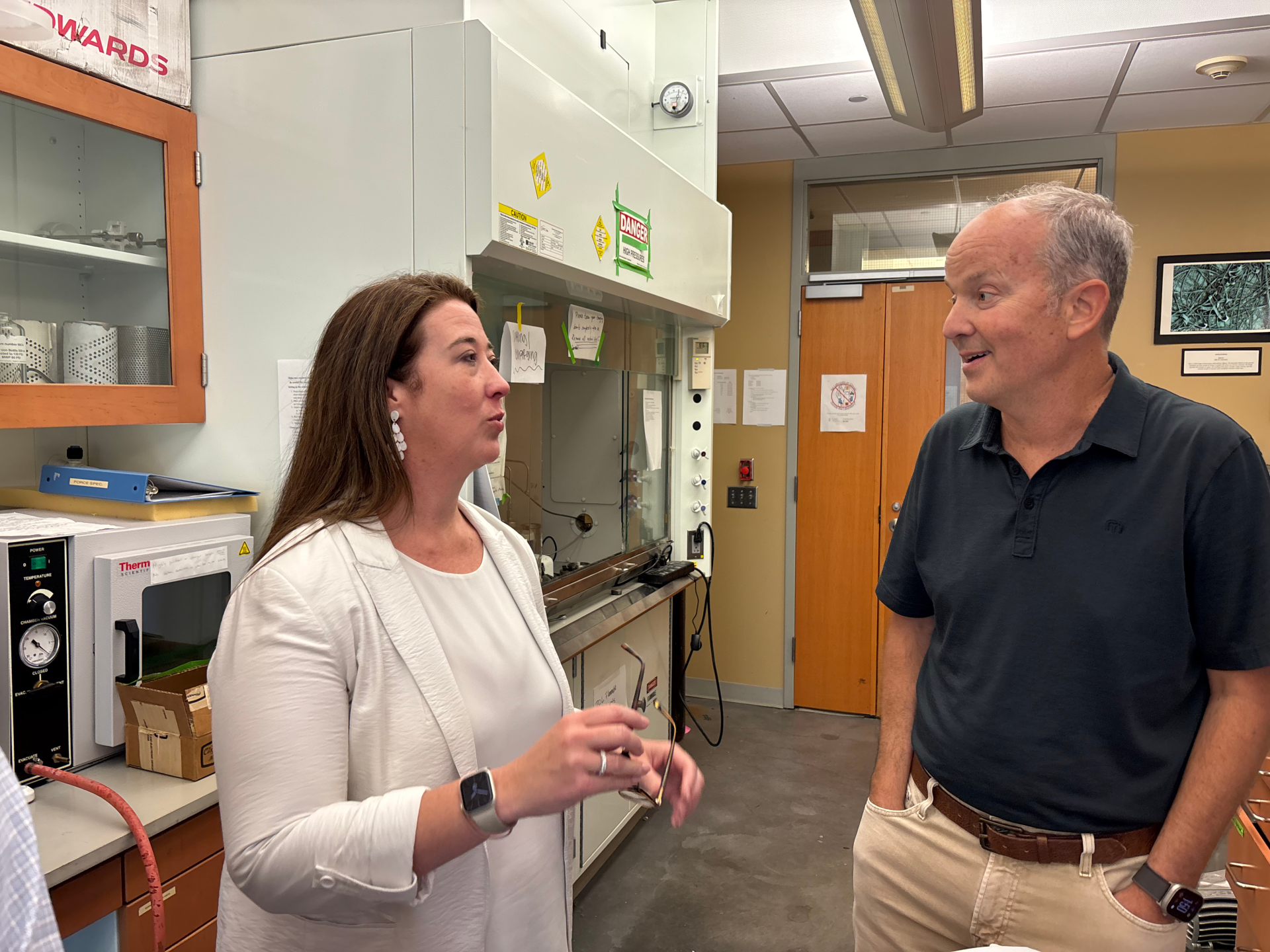
Schoenfisch said he feels “immensely proud” watching former students carry the work all the way to patients.
“Carri and Dan recently invited my current students to visit Pelthos, and it was an amazing experience,” said Schoenfisch, who watched his students marvel at the commercial scale and processes required in industry. “My students really enjoyed seeing all that is required to make drug product for consumer use. It is not something they consider in solving the day-to-day problems encountered in dissertation research. And to be honest, I couldn’t have imagined it either in 2005 when we published the initial research paper.”
Geer and Riccio hope the Nitricil platform technology behind Zelsuvmi might help patients beyond molluscum. The same nitric oxide platform has been studied in other drug candidates that were under development for a range of skin conditions. Those investigational studies show the breadth of nitric oxide’s potential.
“The Nitricil technology could have a much wider reach, either for other indications or in other geographies that could have access to the medication one day,” Geer said. “I’m excited about what comes next for nitric oxide as a therapeutic.”
IMPORTANT SAFETY INFORMATION
What warnings should I know about ZELSUVMI?
ZELSUVMI is for use on the skin (for topical use) only. Do not use ZELSUVMI near or in your eyes, mouth, or vagina.
ZELSUVMI may cause serious side effects, including:
Before using ZELSUVMI, tell your healthcare provider about all your medical conditions, including if you:
Tell your healthcare provider about all the medicines you take, including prescription and over-the-counter medicines, vitamins, and herbal supplements.
Keep ZELSUVMI and all medicines out of the reach of children.
What are the possible side effects of ZELSUVMI?
The most common side effects are application site reactions, including pain, burning, stinging, redness, itching, peeling or flaking, itchy dry skin rash, swelling, breakdown of the outer layer of the skin (erosion), lightening or darkening of the skin, blisters, irritation, and infection. These are not all of the possible side effects of ZELSUVMI.
You are encouraged to report side effects to FDA at 1-800-FDA-1088 or at www.fda.gov/medwatch. You may also report side effects and product complaints to Pelthos Inc. by calling 1-855-330-7546.
Please see the full Prescribing Information, Patient Information, and Instructions for Use for ZELSUVMI on www.zelsuvmi.com
 | UNC-CH