A technology born in a UNC-Chapel Hill lab helped build one startup. Now its leaders are building another, while making the powerful tools behind analyzing biological information faster, cheaper, and far easier to access.
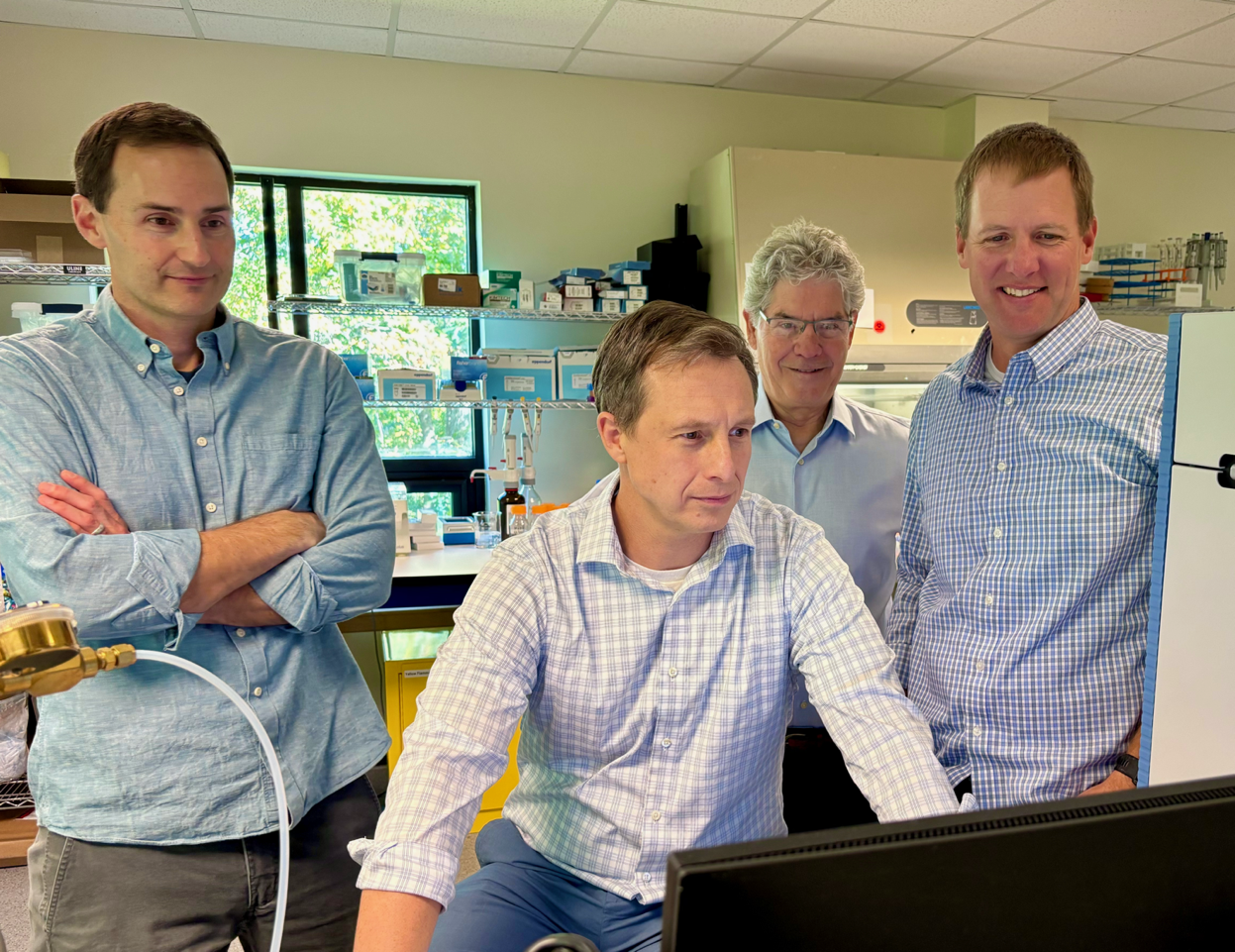
Scott Mellors helped develop a product at 908 Devices based on technology he worked on in Michael Ramsey’s UNC-Chapel Hill lab. Now Mellors, Ramsey, another former Carolina scientist and 908 Devices colleague Will Thompson, and software and AI lead James Campbell are building Move Analytical. Their story shows how experience gained in one startup can help create the next.
The new company is built to save scientists something they never have enough of: time. For labs new to metabolomics, the science of reading the body’s chemistry to understand what’s happening inside, that means months of painstaking lab work compressed into a few days. And once those labs are up and running, or for a lab that’s already experienced, the time it takes to analyze a biological sample and an answer drops from days to minutes. All told, the company’s approach can cut the time to get a result by up to 95%, the payoff of faster sample prep and software that monitors the run and checks the results automatically.
That’s the productivity boost a startup team near the University of North Carolina at Chapel Hill is creating for scientists who measure the molecules behind medical testing and drug development. Their goal: turn one of biology’s most powerful measurement tools into something almost any lab can pick up and use.
The company is Move Analytical, and its founders know the Research Triangle region of North Carolina well. One is Michael Ramsey, PhD, professor emeritus of chemistry at UNC-Chapel Hill and Move Analytical’s founding partner and strategic lead. Over a career that brought about $65 million in federal funding to his UNC-Chapel Hill labs, Ramsey built a series of companies out of his miniaturization and microfluidic research: first Caliper Technologies out of Oak Ridge National Laboratory; then, after arriving in Chapel Hill, the UNC-affiliated spinouts 908 Devices and Codetta Bio.
“Applied scientists ought to work on technologies that address unmet needs,” Ramsey said, explaining that he focused on developing patent portfolios that “could become products and eventually have societal impact.” In Chapel Hill, he found an environment conducive to commercialization, noting that Carolina built “a better climate for spinning out technologies.”
Move Analytical cofounders Mellors and Thompson are both former Carolina doctoral students. Mellors joined Ramsey’s lab after finishing his doctoral degree, first as a postdoctoral researcher and then a staff scientist. It was there that he worked on a tiny chip-based technology (microfluidics) that sorts and measures a broad range of important molecules when paired with a mass spectrometer, a specialized instrument used to weigh and identify unknown molecules. After signing on at 908 Devices, Mellors further developed this technology into a product called ZipChip, a tool used by bioanalytical chemists in academia and the pharmaceutical industry. Thompson also joined 908 Devices, working with Mellors to improve the performance of ZipChip and expand its uses.


When 908 Devices sold its bioprocessing analytics portfolio to Repligen, Mellors and Thompson decided to venture out on their own. They co-founded Move Analytical along with Ramsey and Campbell.
The collaboration is an example of startups begetting startups: one venture creates the people, know-how and confidence for the next. With its research universities, skilled workforce and growing community of experienced entrepreneurs, the Research Triangle region has the ingredients for an innovation economy that builds on its own success. UNC-Chapel Hill has now launched more than 200 startups based on the University’s intellectual property. As ventures like 908 Devices help seed new companies like Move Analytical, the region is building the critical mass of talent and experience that can turn scientific discoveries into lasting businesses, jobs and economic growth.
Move Analytical operates in a field called metabolomics. The word is unfamiliar to most people, but the idea isn’t. Metabolites are the small molecules your cells produce as they go about the business of living, the chemical footprints of what your body is doing at any given moment. Most of the blood and lab tests a doctor orders—for glucose, calcium, kidney markers—are, in fact, measurements of these molecules.
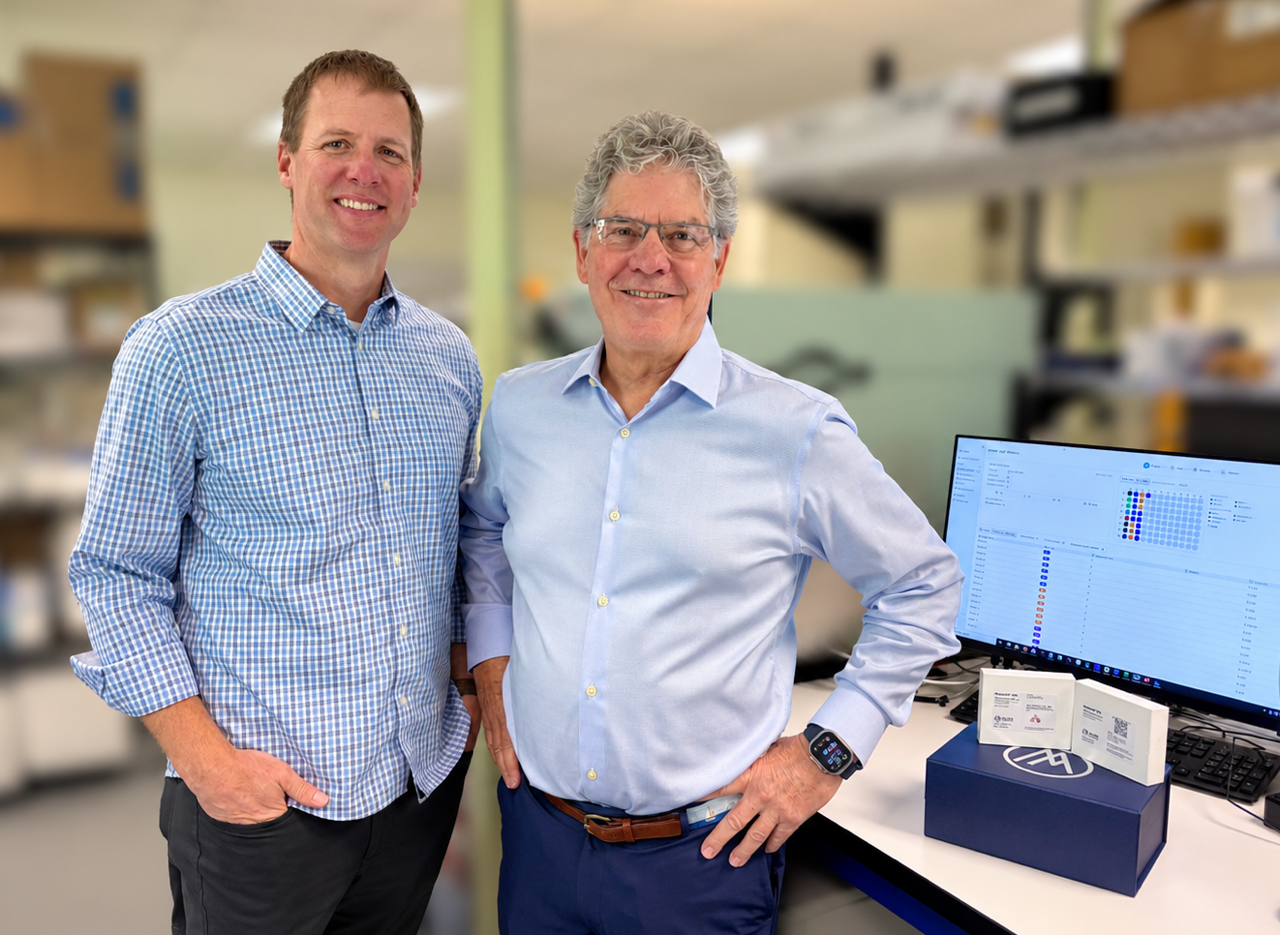
Measuring metabolites can flag disease early, show whether a drug is working or reveal how a body processes food. But the process is complex. Metabolites are a wide and varied set of molecules with very different chemical properties. They’re also small and easy to mistake for one another.
“Advanced analytical chemistry is hard, and it’s generally done by highly trained experts, but the tools they have available are fragmented and tedious to use,” Mellors said. The result: a lab that wants to measure a new set of metabolites can spend months building and validating a method before it gets a single reliable answer.
Move Analytical provides scientists with all-in-one kits paired with software that streamline time and complexity. The kit arrives as a ready-to-use box of chemical ingredients: plates where samples are prepared, reagents that extract metabolites from biological samples, and reference standards for measuring how much of each molecule is present.
Developing an entirely new assay, a lab test that measures how much of a specific substance is present in a sample, can take months. Move Analytical compresses that process down to loading a kit and getting results in a day or two. And the savings don’t stop there. Once a lab has its assays up and running, Move Analytical’s kits and software keep cutting time on every run. A conventional workup requires a scientist to spend two or three days checking peaks and setting up calibration curves by hand. Move Analytical’s approach does the work automatically, cutting as much as 95% of the time and turning days of hands-on work into a result that’s ready almost as soon as the run finishes.
The software provides digital expertise. It sets up the instrument, checks that the system is running properly, watches the data quality as the run proceeds, and does the tedious work of identifying and measuring each molecule. Labs receive a finished report about half an hour after the experiment.
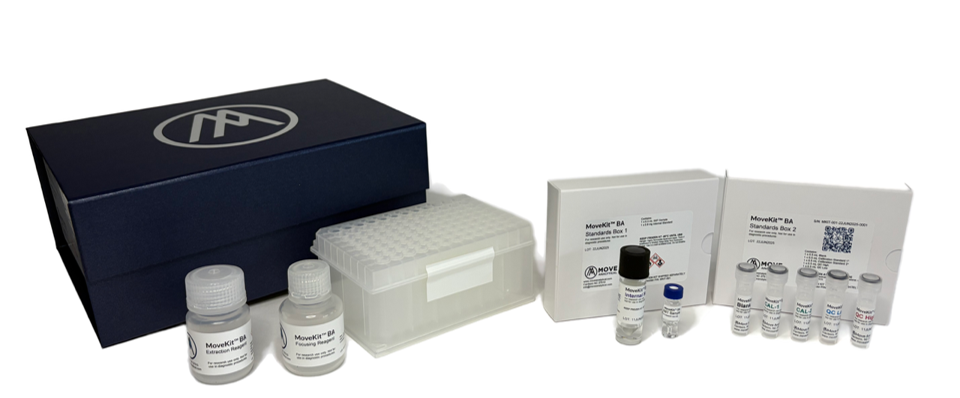
“If you tried to set this up yourself, sourcing all the materials, validating them, and making sure they work, it’s not uncommon for a lab to spend months on it,” said Mellors. “We’re trying to cut all of that out. You just buy the kit and you’re good to go.”
A small biotech company, university lab, or research team without a resident mass-spectrometry expert can suddenly run high-end measurements that were previously out of reach. “It really lowers the bar for someone to run these complicated assays,” Ramsey said. A lab still needs a mass spectrometer and someone who can switch the instruments on and handle basic pipetting, “and that’s about it.”
One class of molecules the kits measure is bile acids, which the liver makes to digest fat. Gut microbes reshape them into a sprawling family of compounds that travel back into the bloodstream and up to the brain.
Bile acids are a window into the microbiome and the “gut-brain axis,” a fast-moving research frontier with possible links to Alzheimer’s, Parkinson’s and other diseases. Move Analytical’s bile-acids kit measures more of these molecules than competing products. The metabolomics group at Thermo Fisher Scientific collaborated on the kit development.
Biopharmaceutical companies also use the kits to monitor living cells inside bioreactors, the large tanks where many biologic drugs are grown, measuring what those cells produce to keep the process running smoothly. As Mellors put it, “these are cells growing proteins that are the drug, and we’re optimizing that process, understanding if something goes wrong, or finding how to make it better.”
The ZipChip technology Mellors first developed as a Carolina researcher, later a 908 Devices product and now a Repligen one, is installed in the UNC-Chapel Hill School of Medicine’s Mass Spectrometry Core Laboratory. The core lab was one of Move Analytical’s earliest partners, among the first to test its new kits.
“The UNC core lab is one of the groups we talk to as we evaluate our new technology and optimize our products, and that’s been a great relationship,” said Mellors. “We have our Move Analytical lab locally in Carrboro, just two miles away from the core lab on campus, so it’s nice having the ability to interact with them often.”
Mellors still remembers how fast the decision came to launch Move Analytical when the Repligen deal freed him to make it. “We kind of made the decision that same day,” he said. A year and a half in, he has no regrets.
Mellors and Ramsey are treading familiar ground. Move Analytical works out the same Carrboro lab used by 908 Devices over a decade prior. Similar to 908 Device’s trajectory, they expect Move Analytical to scale. “What’s ahead is expanding the number of molecule types we can provide kits for, which will drive volume,” said Ramsey. “As people use the MoveKits, they’ll understand the simplicity and the reliability of the results.”
 | UNC-CH