
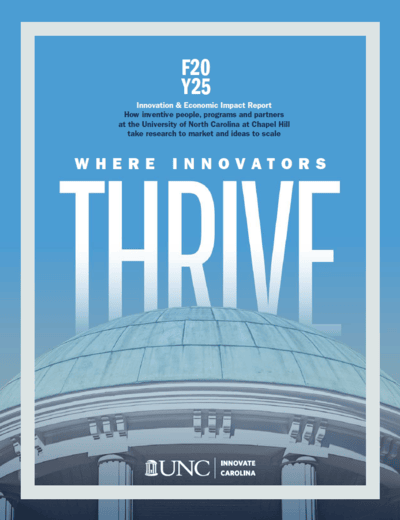
This week, Innovate Carolina announces the release of its fiscal year 2025 (FY25) innovation and economic impact report, which describes the significant human and economic impact made by startups, products and entrepreneurial initiatives connected with the University of North Carolina at Chapel Hill. The report outlines results achieved by innovation-oriented people, programs and activities across the University, including those involved with technology commercialization, UNC-affiliated startups, innovation gap funding, innovation services and support, entrepreneurship education and talent development programs, and innovation-related hubs and communities. Data from FY25 show:
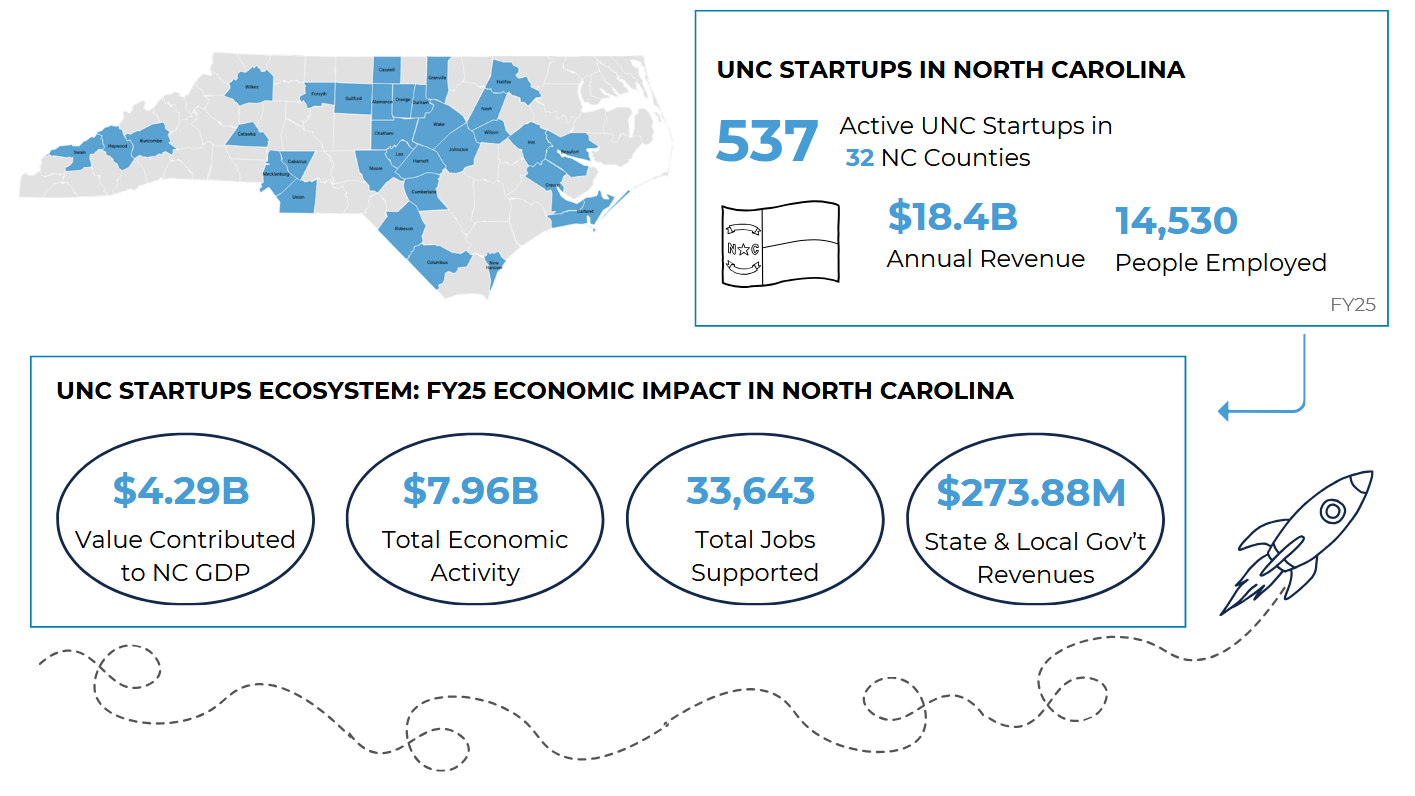
- $4.29 billion contributed by UNC-affiliated startups to North Carolina’s Gross Domestic Product (GDP) during FY25.
- Nearly $8 billion in total economic impact driven by UNC-affiliated startups in North Carolina during FY25, including $4.17 billion in direct impact, $2.14 billion in indirect impact, and $1.65 billion in induced impact.
- Greater than 20 percent growth in four core commercialization categories in FY25 compared to FY24: invention disclosures (+21%), provisional patent applications (+29%), issued U.S. patents (+30%), and IP-based startups launched (+33%).
- A record year for new startups founded on UNC intellectual property (IP), with 12 IP-based companies launched in FY25, tying the all-time high mark previously reached FY21.
- The largest single-year rise in National Academy of Inventors (NAI) global rankings for UNC-Chapel Hill, with the University moving up 32 spots on the latest NAI Top 100 Worldwide University List.
- 682 active UNC startups, with 537 (79%) headquartered in North Carolina, creating more than 131,000 jobs worldwide and more than 14,000 jobs in the state.
- $48.9 billion in cumulative funding raised by 1,273 UNC-affiliated startups since 1950, with $4.6 billion raised in FY25.
- $33 billion in cumulative funding raised by UNC startups receiving University-based innovation gap funding and/or in-kind program support—representing 285 times more raised than the $117 million in gap funding provided by the University all-time.
- More than 4,000 faculty and student innovators trained all time via entrepreneurship and innovation-focused workshops, training programs, fellowships and internships—with nearly 650 participating in FY25.
This report describes the activity and impact related to innovation, entrepreneurship and economic development at UNC-Chapel Hill during FY25. Explore data and insights across six sections:
- Technology commercialization
- Startups
- Innovation gap funding
- Innovation services and support
- Entrepreneurship education and innovation talent
- Innovation hubs and communities
Download Full Impact Report
‘Make Carolina a place where innovators thrive’
As the volume of foundational research and number of valuable ideas at the University grow, Innovate Carolina built a strategy for translating more of the inventive thinking and discoveries that emerge from our labs and classrooms into products, services and companies that make a tangible impact for the people and economy of North Carolina. The University’s innovation pipeline is driven by faculty who conduct research and develop new inventions, enterprising students who pursue bold solutions, staff who offer support, entrepreneurs who found new ventures, alumni and partners who invest, and donors whose generosity fuels momentum. The new report is a snapshot of the impact made by many people working together to make Carolina a place where innovators thrive.
537
active UNC startups headquartered in NC (FY25)
$4.29B
contributed by UNC startups to North Carolina’s GDP (FY25)
$7.96B
in total economic activity stimulated through UNC startups in NC (FY25)
The latest findings reflect data from more than 20 UNC-Chapel Hill departments and innovation programs, affiliated organizations and partners, and Innovate Carolina, the campuswide initiative for innovation entrepreneurship and economic development. For over a decade, Innovate Carolina’s data hub has provided a detailed snapshot of startups launched by faculty, students, staff and recent alumni, including a cumulative record of outcomes for both IP and non-IP-based ventures. This novel, proprietary database platform captures and reports on how the University’s commercial and social ventures make an impact.
Innovate Carolina provides a comprehensive pipeline for turning innovation into societal and economic impact, offering support and services to faculty, staff and student entrepreneurs at UNC-Chapel Hill and to those outside the University. For instance, through its Office of Technology Commercialization (OTC), Innovate Carolina connects and translates the pipeline of research and ideas from campus to the outside world. Since 2006, OTC has facilitated the commercialization of 42 research-based products.
- In FY25, Carolina’s commercialization team worked with researchers on 158 invention disclosures and 94 new provisional patent applications, contributing to a cumulative total of 4,776 and 1,994 respectively.
- Licensing revenue for the fiscal year reached $6.2 million, bringing the all-time total to $145.9 million.
- Sixty U.S. patents were issued to UNC-Chapel Hill inventors during FY25, increasing the University’s cumulative number of issued U.S. patents to 1,426 all time.
>> Download Full Visual Summary
UNC Startup and Technology Standouts, FY25
A number of UNC-affiliated startups and research-based products made recent advances and reached significant milestones:
- Liquidia secured U.S. Food and Drug Administration (FDA) approval and made its first commercial shipment of YUTREPIA for the treatment of pulmonary arterial hypertension and pulmonary hypertension associated with interstitial lung disease.
- G1 Therapeutics, whose flagship product Cosela was the first therapy cleared by the FDA to reduce bone marrow damage associated with certain chemotherapy regimens, was acquired by drugmaker Pharmacosmos for $405 million.
- TSHA-118, an investigational gene therapy candidate based on a technology invented at UNC-Chapel Hill to treat CLN1 disease (Batten disease), was administered to a patient for the first time. Batten disease is an inherited and fatal neurodegenerative disease that affects infants, toddlers and children.
- SonoVascular, a startup company developing a blood clot-breaking ultrasound technology for safer treatment of deep vein thrombosis, conducted its first-in-human clinical trial.
- Carpe, a startup founded by two students (now alumni) of UNC-Chapel Hill and Duke University that achieved nationwide retail reach for its novel antiperspirant product, was acquired by private equity firm Topspin Consumer Partners.
- Couplet Care launched a medical device for improving inpatient postpartum care, making its new bassinet product available for purchase by hospitals in the United States.
- IotaComm, a wireless connectivity and smart-tech company with an FCC-licensed spectrum portfolio and data-driven solutions for smart buildings, graduated from the Innovate Carolina Junction coworking hub and established a new and expanding office headquarters in downtown Chapel Hill.
Impact Report by Section
Explore the FY25 innovation and economic impact report by section. Each section includes a mini content guide, allowing you to jump directly to the data and insights you’re most interested in.