Cole leads Innovate Carolina’s strategy for connecting banks, insurers, asset managers and fintech firms with UNC-Chapel Hill.
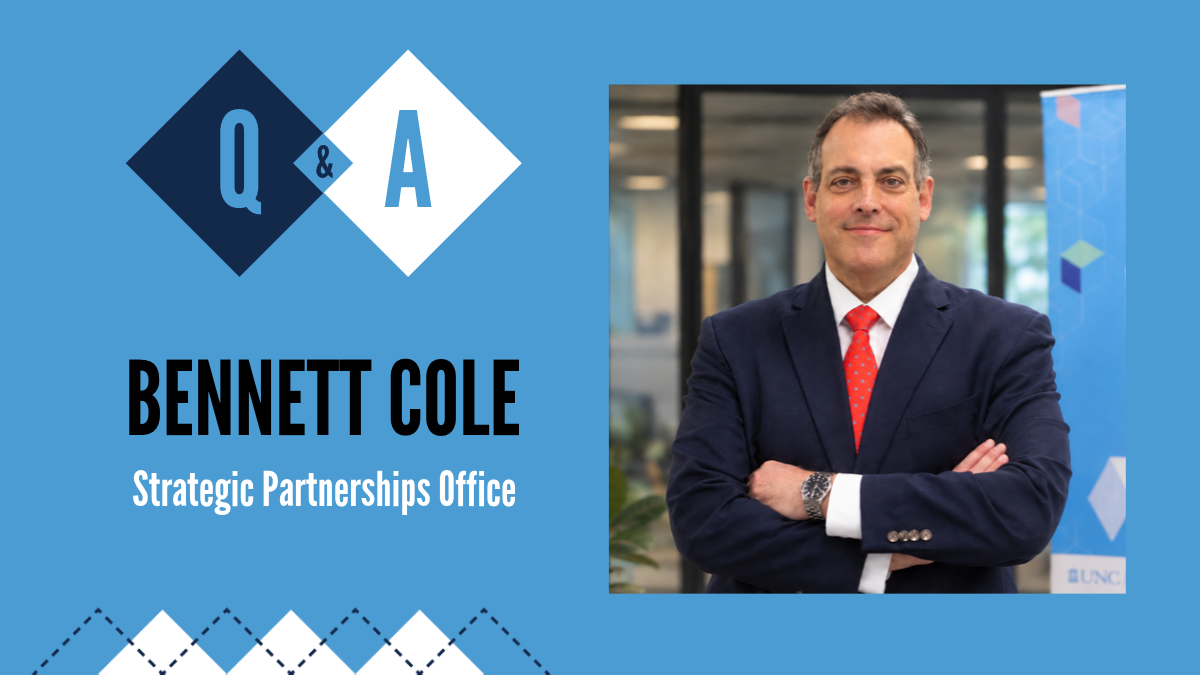
For more than three decades, Bennett Cole built his career in financial markets: investment banking, private equity and capital markets. Now he’s bringing that experience back to his undergraduate alma mater. As senior adviser to the vice chancellor and executive director of industry partnerships at UNC-Chapel Hill, Cole leads Carolina’s strategic partnerships across financial services, connecting banks, asset managers, insurers and fintech firms with the University’s researchers, students and expertise. He joins Carolina after moving into higher education in 2023, most recently leading industry relations at the University of Wisconsin-Madison’s Wisconsin School of Business.
Cole works within the Strategic Partnerships Office, launched by Innovate Carolina, the Vice Chancellor’s Office for Innovation, Entrepreneurship and Economic Development. The office is building a front door to the University for industry, government and community partners. Below Cole shares his perspective on what financial services firms want from a university partner, where Carolina stands apart and how he plans to connect it with partners beyond campus.
In investment banking, the part I valued most was bringing the right people and the right capital together, so both sides came out ahead. University partnerships are the same work on a longer horizon. At their best, they shape both the institution and the company for decades. Coming back to Carolina is personal. Kenan-Flagler Business School gave me the foundation for my career, and I’ve wanted to give back in a way that matters. I came back because I know I can create lasting value at my alma mater.
I work with financial services companies broadly, from banks and asset managers to insurers and fintech firms. The most valuable work isn’t transactional. It’s helping a firm build a long-term, durable relationship with a top research university. When I sit down with a leadership team, I don’t start with our programs. I start with what keeps them up at night: where their future leaders will come from and how AI will reshape their business. Then we build a partnership around those goals using the whole university: talent development, research, executive education and a visible role on campus and in the state.
Most firms are asking the same question: what does our organization look like in 10 years? AI, new competitors, a shifting regulatory environment and an evolving workforce are hitting at once, and the decisions leaders make now will shape their firms for a generation. That’s where a research university becomes a strategic asset, not just a recruiting stop. Senior executives don’t want just another sponsorship; they want a partner whose success is tied to their own and still produces value years from now. Carolina is built for that. We pair the depth of a top 10 public research university with an alumni network that runs throughout financial services, and we’re home to one of the most active states in the country for financial services. Then there’s Carolina North, a new campus where industry, faculty, students and technology will converge, giving a firm a rare chance to shape the future and build a lasting presence in an innovative environment.
Chancellor Lee Roberts and Vice Chancellor Tommy Sowers talk about being the front door to the University. After it opens, a financial services leader should find a counterpart who understands their firm, knows how they’re already connected to Carolina, and can quickly bring the right people across our schools and centers to the table. Being easy to work with means thinking like a partner, not a vendor, with commitments on both sides. The partnerships I want are ones where, five to 10 years out, both sides can point to what they built together and call it transformative.
I see my role as a resource for the University’s schools and centers, not a replacement for the relationships they’ve built. People assume financial services means Kenan-Flagler, and it will be a major player. But firms are just as interested in economics, data science, public policy, law, risk, research and even the arts. Many of our best relationships already exist in pockets across campus. I want to understand them, strengthen them and connect them to opportunities those units might not see on their own. We’re most differentiated, and most relevant, when we work as one Carolina.
Financial services is one of North Carolina’s defining industries. Charlotte is the second-largest banking center in the country, and firms are adding jobs across the Triangle and beyond. And this isn’t only about large institutions. Community banks, credit unions and financial planning firms anchor small towns across the state, and questions like access to capital and financial literacy affect every county. Carolina can help these firms grow their workforce and their communities at the same time. It’s a direct extension of our longstanding commitment to the state.
The arts. Carolina has extraordinary cultural assets: Carolina Performing Arts, the Ackland Art Museum, Morehead Planetarium and more. Financial services companies have historically been among the nation’s leading supporters of the arts, and partnering with Carolina lets them do that with real impact and visibility. The strongest partnerships often combine a firm’s business goals with what it stands for in the community. The arts are one of the best ways to bring those together.
Carolina alumni are everywhere in financial services, from Charlotte to New York to firms around the world. Many are in senior roles. They’re often the reason partnerships happen: they open the door, make the case internally and understand what both sides need. Here’s my call: if you’re an alum in financial services who wants to help your firm build deeper ties with Carolina, I’d love to hear from you. My phone is always on, and my door is always open.
What probably surprises people most is my hobby: watchmaking. I’ve been fascinated by mechanical timepieces for decades, and during the pandemic I finally learned to build and repair them. There’s something deeply satisfying about a few hundred tiny parts, each with a precise job, coming together into something that, done right, can last for decades. It takes patience, a steady hand and a willingness to start over when something isn’t right. Which, come to think of it, isn’t a bad way to think about partnerships either.
Interested in building a strategic partnership between the University and the financial services industry? Connect with Bennett Cole at bscole@unc.edu or learn more at partner.unc.edu.
 | UNC-CH