Clinical psychologist, entrepreneur and alumna Dr. Stephanie Sacks traces her path from a Carolina lecture hall to her present work, offering advice for students weighing uncertain paths.
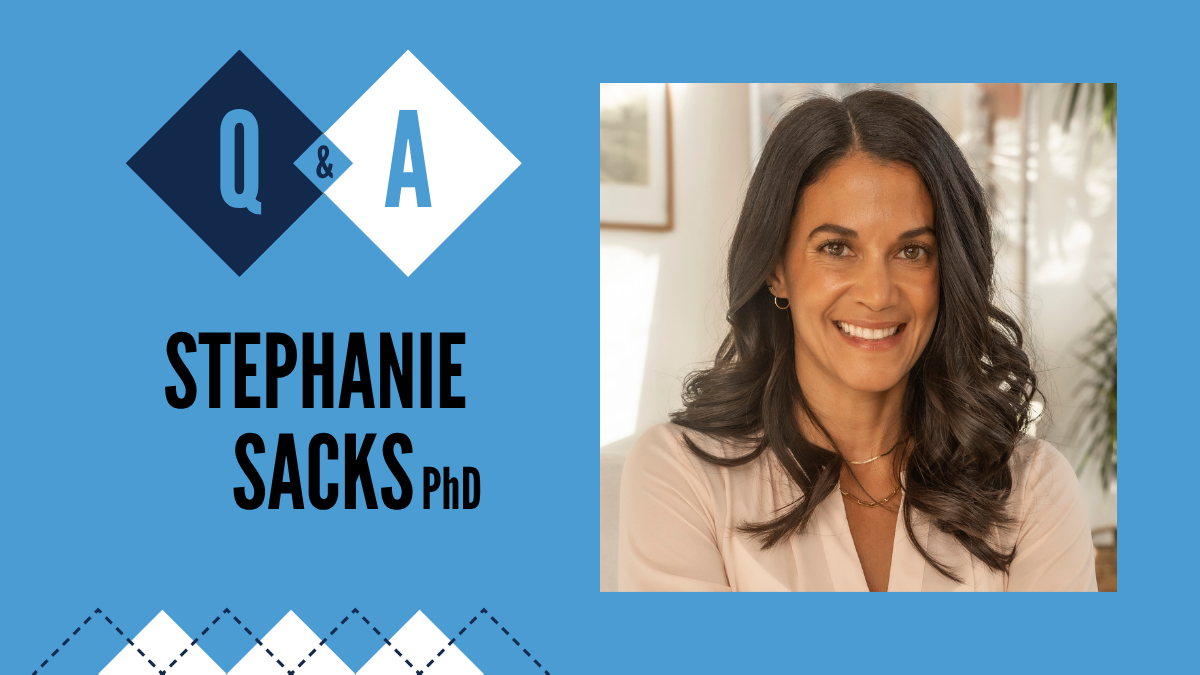
Carolina alumna Dr. Stephanie Sacks ‘05 (BA, UNC-Chapel Hill; PhD, University of Miami) is a licensed clinical psychologist working at the intersection of trauma treatment and entrepreneurship. Since 2018, she’s run her own practice, the Cognitive Behavioral Therapy Center of the Palm Beaches in Boca Raton, Florida. She uses evidence-based cognitive behavioral therapies to treat Posttraumatic Stress Disorder (PTSD) and other Trauma- and Stressor-Related Disorders, OCD-Spectrum Disorders, and Anxiety Disorders.
Sacks is a national trainer and consultant in Cognitive Processing Therapy, a gold-standard PTSD treatment and an Adjunct Professor at Nova Southeastern University and the University of Southern California (Voluntary). She is also Co-Founder, Chief Financial Officer and a lead instructor of MindScience Collective, a continuing education platform for mental health professionals.
Little reduces us to what’s pure about the human condition the way trauma does. Trauma doesn’t discriminate. It can happen to anyone. My route to treating this population was circuitous. It started at UNC, while engaging in clinical research with people living with Schizophrenia-Spectrum Disorders. I quickly realized how prevalent trauma exposure is in these individuals. It turns out that they have a disproportionally higher risk of experiencing all kinds of traumatic events. It was really challenging work. And it changed my life. That experience drove decisions I made regarding my pre-doctoral internship, postdoctoral fellowship and the challenges I took on to become an expert in this area.
What keeps me passionate is supporting people’s recovery. I’ve worked with people who have endured the most horrific circumstances. And have been honored to witness how immense human resilience can be. Implementing the most effective therapies for trauma-related symptoms like PTSD, means you can see someone who can’t sleep, work or connect get their life back. I get to be a facilitator of that change, and I can’t imagine more fulfilling work.
Two pivotal moments at UNC shaped my professional life. First, I was pre-med until junior year. In my sophomore year, I enrolled in an intro to psychology elective, and it planted a seed. I took more psychology elective courses, and one day while I was sitting in a chemistry lecture, I found myself daydreaming about my personality psychology class. I realized then that the healing I was meant for was about the psyche, not the organs. It’s why I encourage students to take classes they don’t expect to like. You never know what clicks.
Second, after switching majors, I contacted Dr. Aysenil Belger, a UNC psychiatry professor and neuroscientist. She met with me for two hours. My senior year I designed my own year-long independent study under her mentorship. As a woman in science and an immigrant like me, Aysenil made what I wanted to do feel possible. I learned that if you see a gap, you can create anything.
I first worked in places where I wasn’t in charge — a Veterans Affairs hospital in Washington, DC, and a group practice — and wouldn’t have succeeded without lessons learned there. When I built my own practice, I wanted to challenge myself, make mistakes and learn from them, and curate exactly the career I wanted. And there’s the flexibility: when I want to kick work into high gear, I can; when I need to take a beat, I can.
Journalists face distinct stressors: financial instability, being underpaid and overworked, and skepticism about their craft that runs against their core value of truth-telling. Newsrooms rarely train anyone for the trauma the job entails, like reporting from the scene of a mass shooting. My work with journalists started when I learned about a pilot study at the Dart Center for Journalism and Trauma, part of Columbia University’s Journalism School. I joined the program’s first cohort. The program provided training in journalistic culture and was funded by a grant that allowed a handful of psychologists to provide trauma-focused clinical services to journalists.
My amazing co-founders and I are all entrepreneurs who’ve run successful businesses before. What anchors us is the understanding that not all psychotherapy modalities are equal. There’s a real difference between methods that feel supportive and nice and those that have direction and structure and that drive real change. We’re committed to giving all therapists access to evidence-based learning about psychotherapy methods that actually work—meaning that they help clients experience significant symptom change and often enter remission. It takes 17 years, on average, for rigorously studied interventions in university or research settings to reach clinicians on the ground. We bridge that gap by having our fingers on the pulse of the latest science and packaging it in a way that therapists can start using it with clients today.
My identity as an immigrant has been an essential factor while finding my way as a psychologist and entrepreneur. I immigrated to eastern North Carolina from the Dominican Republic at seven, when there was very little ethnic and cultural diversity there. I’ve since learned that immigrants are disproportionately more likely to start businesses: roughly half of Fortune 500 companies are founded by immigrants or their children. There are certain theories about why, and one is that the act of immigration itself requires a high level of risk tolerance. You leave everything you know — language, food, culture, values, social rules — for the complete unknown. This higher risk tolerance lends itself beautifully to building businesses. I didn’t speak a word of English when I started school in the US. It’s like going to Mars and telling yourself you just have to figure it out. If you can do that holistically, doing it as a business owner feels manageable. You inevitably learn grit.
First, practice willingness to tolerate uncertainty, make mistakes, and not know if everything will work out. If we insist on knowing things will go well, we will do very little. Second, talk to people who’ve done it. When I was a student, I emailed Aysenil thinking she’d never take a meeting with me. But I did it anyway. The lesson is to put yourself out there and look for people who are doing things you think are awesome. Ask them for a little bit of time. Third, be honest with yourself about what’s workable. You don’t have to feel limited to traditional paths that feel safe if they don’t inspire you. You can cobble together exactly the professional life you want, even if you don’t know what it looks like yet.
Connect with Dr. Sacks on LinkedIn. She’s happy to lend advice to Carolina students, including future Tar Heel psychologists and entrepreneurs.
 | UNC-CH