UNC-Chapel Hill innovation initiative Innovate Carolina announced awards for four new human-centered design innovation projects focused on early-onset cancer care, reducing bullying of autistic youth, boosting student wellness and improving rural emergency response.
David Ansong and his team understand the pattern: A young person commits a poverty-related crime. They become incarcerated in a juvenile detention center. They are released only to commit another poverty-driven survival crime that lands them in legal trouble yet again.
“When these young people exit the centers, they often face low educational outcomes, limited skills, unemployment, mental health challenges, and the stigma associated with criminal justice involvement,” said Ansong, PhD, a professor at the School of Social Work. “Once a young person has contact with the system, the consequences can compound and narrow economic mobility and future opportunities in ways that are difficult to reverse.”
Years of research on financial capability and vulnerability have shown Ansong’s team the economic conditions that place young people at risk of incarceration, trafficking, and other survival-driven harms. They are now working to break that cycle through a contextualized intervention that strengthens financial guidance, financial inclusion, and reentry support for young offenders. Ansong, together with Emmanuel Amoako, an emerging scholar in the economics of incarceration, leads the team. The goal is to help young people return to their communities and avoid future incarceration by improving their economic security and financial capability.
Ansong’s project is one of many community-centered innovation efforts at the University of North Carolina at Chapel Hill now supported by the Translating Innovative Ideas for the Public Good (TIIP) Awards. The goal of the awards is to move UNC innovation beyond research papers and labs and into communities. Through the TIIP program, faculty teams receive funding that allows them to work directly with the people they hope to help. They design solutions alongside patients, students, families, educators, industry and community partners to address urgent real-world challenges.
As universities increasingly focus on demonstrating real-world impact, programs like TIIP are helping researchers move ideas more quickly from concept to community use.
This year, Innovate Carolina announced four new TIIP award recipients whose public-good innovation projects span student wellness, cancer care, autism support and emergency response innovation. The announcement came during the program’s TIIP Awards recognition reception. The session also highlighted progress from two previous award recipients: Ansong for his work building a financial guidance model for incarcerated youth in Ghana that is now garnering interest from the North Carolina Department of Public Safety; and Melissa Cox, PhD, an associate professor at the Gillings School of Global Public Health focused on high-risk alcohol use in young adults.
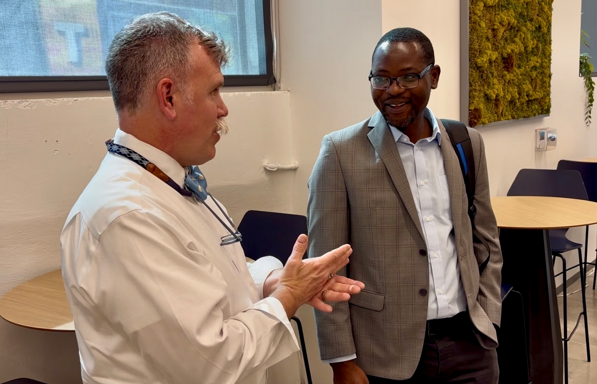
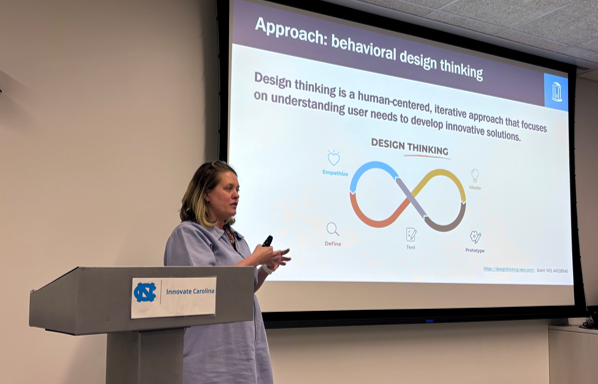
Cox’s team used TIIP Award funding partnered with Innovate Carolina and young adults to co-design a smartphone-based intervention that delivers personalized support and behavior-change messages during high-risk drinking situations, showing early signs of reducing risky alcohol use. “I wanted to make sure this work didn’t just stay inside academia or the research lifecycle,” Cox said. “The end goal is not a randomized controlled trial. The end goal is evidence that informs something that can actually go into the world.”
Innovate Carolina created the TIIP awards to help faculty and staff translate promising research and innovation ideas into practical, scalable public-good solutions. The awards support human-centered design innovation projects that use co-creation with communities and real-world testing to ensure solutions are desirable, feasible and sustainable. The program also connects researchers with design thinking expertise, commercialization guidance and innovation resources across the university.
“The TIIP Awards support innovative projects from faculty and staff who focus on the human experience and co-creating with the people in communities,” said Bill Romani, PT, PhD, director of Innovate Carolina’s Design and Innovation for the Public Good team. “We’re not just bringing ideas to the community. We’re working with the community to identify, test and translate ideas into innovations that actually work and serve people effectively.” The program reflects a broader shift at Carolina toward community-centered innovation and designing research alongside users and communities from the beginning.
Since launching in 2023, TIIP has awarded nearly $560,000 to 13 cross-disciplinary public-impact innovation projects spanning medicine, public health, social work and technology. The projects address issues ranging from maternal health and mental health to financial empowerment, rural healthcare and community wellness.
This year’s awardees are tackling a range of public challenges.
Wayne Rosamond, PhD, professor, Department of Epidemiology, Gillings School of Global Public Health

Rosamond is exploring how integrating the use of drones carrying automated external defibrillators (AEDs) with existing emergency medical services could help save lives during cardiac emergencies in rural communities.
Out-of-hospital cardiac arrest survival drops dramatically with every minute that passes without CPR or defibrillation, yet emergency response times in rural areas are often delayed. Using an aerial drone to deliver of an AED to the site of a cardiac arrest may assist bystanders in these situations, reduce time to defibrillation, and increase the chances of survival. Rosamond’s IN-AIR Roadmap project will work with several EMS agencies in North Carolina, emergency responders and community members to test how drone-delivered AEDs could fit into real emergency systems. Through simulations, demonstrations and community engagement, the team hopes to create a scalable roadmap for improving emergency cardiac response across North Carolina and other rural regions.
Jimikaye Courtney, PhD, assistant professor, Department of Exercise and Sport Science
Courtney’s work focuses on helping college students build healthier habits through outdoor activity and access to nature. The project will partner directly with Carolina students to co-design a physical activity program centered around green spaces like parks, trails and gardens.
Research shows many students struggle with stress, anxiety and declining physical activity during college. Courtney’s team found that even short walks in nature can improve mood, energy and motivation to stay active. Through focus groups, workshops and pilot testing, students will help shape a nature-based program — from activities to delivery methods — with the goal of creating a scalable wellness model that fits naturally into students’ daily lives at Carolina and other colleges and universities.
Carmina Valle, PhD, associate professor, Department of Nutrition, Gillings School of Global Public Health
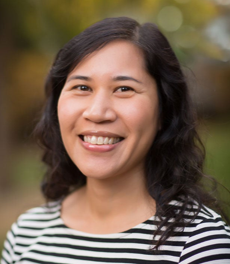
Valle is leading a project with nutrition doctoral student Rachel Sauls, focused on improving recovery and well-being for adults diagnosed with cancer before age 50. Called Thrive Prehab, the initiative will work with newly diagnosed patients and cancer survivors to co-create prehabilitation support strategies that help people prepare physically and emotionally before cancer treatment begins.
The project focuses on nutrition, physical activity and functional health during the critical period between cancer diagnosis and treatment. Rather than assuming what patients need, the team will use a human-centered design process to shape the intervention directly with patients themselves, potentially through a digital or mobile platform designed around real-life needs and constraints.
Hannah Morton, PhD, assistant professor, TEACCH Autism Program, Department of Psychiatry, School of Medicine

Morton and collaborators are developing a digital platform designed to help autistic youth more safely and accurately report bullying experiences. Traditional written bullying questionnaires can miss forms of bullying uniquely experienced by autistic or disabled students and may not feel accessible or safe to use.
The team’s assessment platform uses short, animated scenarios with customizable avatars to help adolescents communicate difficult experiences in ways that feel safer and easier to understand. In collaboration with community groups of autistic adolescents and school professionals, the project will continue developing the digital tool through co-design sessions and prototype feedback with the goal of improving early identification, intervention, and prevention of bullying.
 | UNC-CH