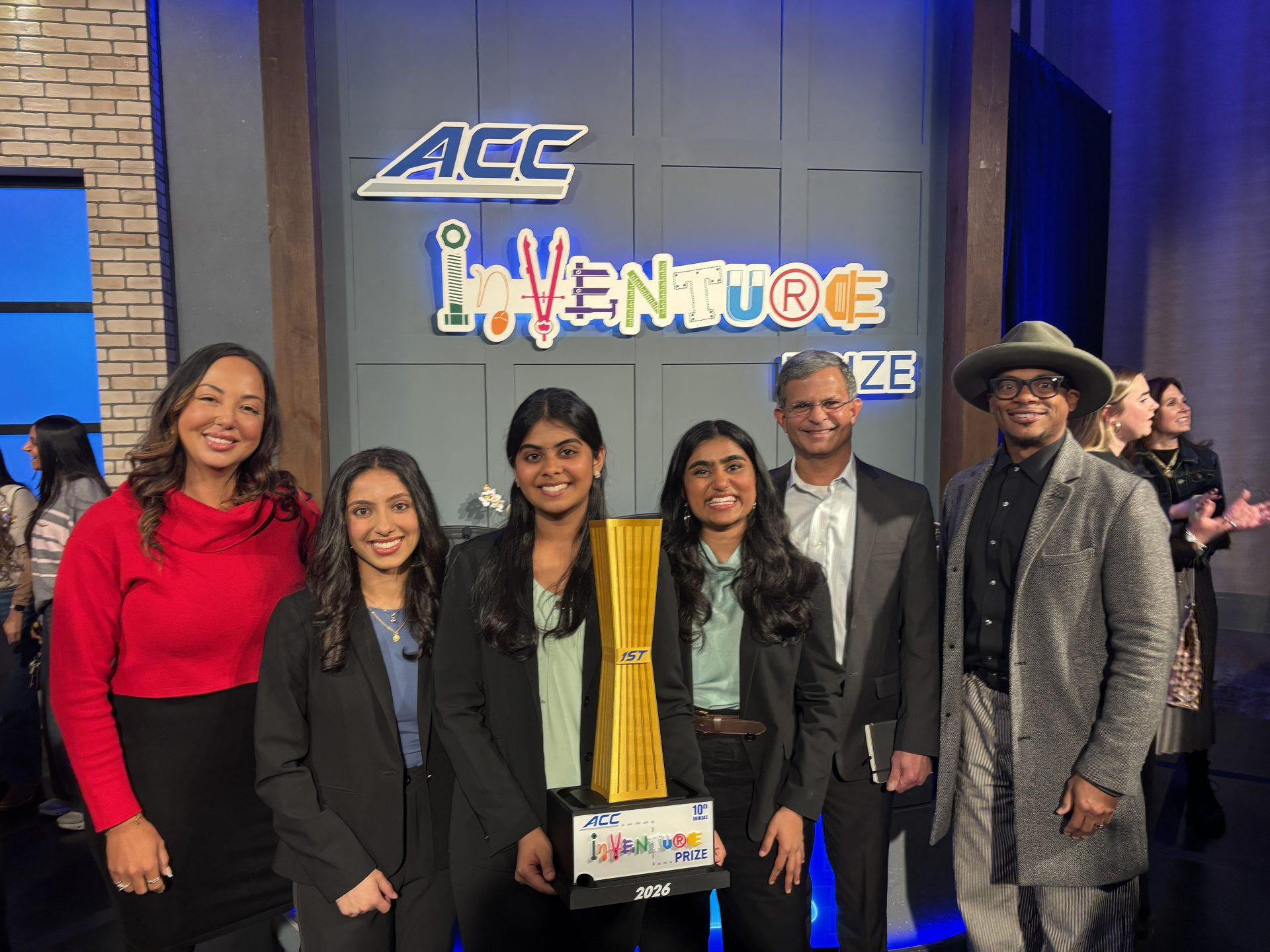
In March 2026, student leaders of UNC-affiliated startup Sensible made Tar Heel history: the first Carolina student innovation team to win first place at the ACC InVenture Prize—a battle of the best student entrepreneurs in the Atlantic Coast Conference.

Sensible, a startup founded by Carolina students, is developing a pad-attachable patch that turns menstrual blood into wellness signals during everyday use. Its patent-pending diagnostic technology could enable earlier detection of conditions like endometriosis without invasive testing. With funding support from Innovate Carolina and mentorship from Launch Chapel Hill, three of the company’s leaders attended the ACC Inventure Prize at Notre Dame University: Nandini Kanthi (neuroscience and community and global public health; CEO at Sensible), Vaishnavi Kode (economics and biology; Vice President of Growth at Sensible) and Vrutika Soneji (health policy and management and neuroscience; COO at Sensible). Other founders of Sensible include Juliet Wu (undergraduate student at the University of Pennsylvania, CFO at Sensible) and Ishita Bafna (senior at Enloe High School in Raleigh; CTO at Sensible).
The trio of Kanthi, Kode and Soneji represented the team and competed with top student innovation teams from 13 other schools across the ACC, returning to Chapel Hill with a $15,000 first-place prize.
Nandini Kanthi: Whenever we go on stage or into a room to talk, the most important thing is the story of why we’re building Sensible. We’re empowering women with knowledge about their bodies that they have never had access to. Our hope is that through every win and conversation, we find one more way to shape people’s perceptions about what’s possible.
Vaishnavi Kode: It’s incredibly reassuring for us to get on stage and share our story. Our idea may seem like a wild one, but we’ve seen so much promise in what we’re building. We love interacting with a new audience and seeing their faces change and react to the idea that we’re throwing at them. At first, they may seem a bit confused, but then there’s the moment of clarity. You see it toward the end of our pitch when we talk about our solution, physically take a step forward and ask everyone in the crowd to join us. That’s the moment when everyone gets excited.
Vrutika Soneji: This experience has been especially exciting because of the support our team received. Even in the back room at the competition, all the startups from different schools across the U.S. said, “Hey, that’s a cool product. How can we help one another?” The judges have been so willing to share their time and expertise to help us continue the momentum.
Nandini: There hasn’t been enough research on women’s health or tools that women can access to learn about their bodies, whether they’re at risk for life-threatening cancers or extremely painful conditions like endometriosis or PCOS. We’re creating a technology—a patch placed within an existing menstrual pad—designed to give women a better understanding of their health from the comfort of their own homes. Menstrual blood contains about 385 proteins that the systemic blood you normally get drawn at the doctor’s office does not. That means many women go their entire lives not knowing 385 data points about their bodies that could lead to early diagnoses or tell them more about their health. Maybe you’re at risk for a disease like endometriosis, which historically has a seven-to-nine-year diagnostic timeline. We believe that we can screen for those issues easier and earlier.
Vrutika: We approach partnerships from multiple angles. One is customer discovery. We’re having conversations with OBGYN clinics and hospital system clinicians to understand what a day in the life is like for them, the challenges they face, how our product can address those pain points, and how we can adjust what we’re designing to fit into their clinical workflows. The more touch points we have with the people who will eventually use our product, the better. Second, we’re thinking about long-term relationships. We’d eventually love to pilot and roll out our product in these clinics. So, we’re starting now by having these open conversations to build a deep foundation of trust for the future.
Nandini: When building our product, the ultimate goal is to make it useable for the everyday patient. As our end customers, patients will learn about our product from the people they trust: their providers who already have a deep understanding of their health. So, we hope to stay connected with these providers because it’s important to establish trust, especially when introducing a new medical technology.
Nandini: We’ve been preparing for this competition since we started Sensible, and that’s because the innovation community at UNC is incredibly generous. Our first contact point was the Gillings School of Global Public Health, where we won the 2024 student pitch competition. That was the first trial run for the pitch that evolved into our presentation at the ACC InVenture Prize. Since then, we participated in Carolina Pitch Fest, a campus-round qualifier for the Hult Prize at UNC, the 1789 Student Venture Fund, and the Launch Chapel Hill Student Summer Accelerator. When preparing for the ACC InVenture Prize, the people at Launch Chapel Hill and Innovate Carolina were essential. They organized pitch practice sessions and connected us with the team that represented UNC at the ACC competition last year (Scyntek) so that we could hear their perspective. We wouldn’t have had the same confidence going into the room at the ACC InVenture Prize if we weren’t so well prepared.
Vrutika: There’s one piece of advice from the competition prep that I’ve been applying to the rest of my life. Throughout our trip, our competition advisor from Launch Chapel Hill told us that we know the content. We just need to go up there and show our passion for what we know. There’s no reason to be nervous.
Nandini: The ACC InVenture Prize was one of the most challenging pitch competitions we’ve been to. Typically, judges either focus on teams with the best business models or teams with the most technical strength. The ACC InVenture Prize is great balance of both. The judges asked us detailed questions about the technology we’re building, yet we had to communicate in a simple way that anyone could understand. The questions were opportunities to tell our story and also discuss regulatory procedures, compliance and nitty-gritty details that we don’t typically talk about in our main pitch.
Vaishnavi: The ACC InVenture Prize was energizing. Every person in the room was incredibly bright and passionate. Here was a space with so much synergy between teams of students who are all navigating a college environment while working on big ideas. We had conversations and bounced ideas around with students from NC State University and Clemson University. They gave us new ways to think about Sensible, and we offered new perspectives that they hadn’t thought about. You’re also pitching to two audiences: the judges and then the general public in the auditorium and on the live-stream broadcast. You have to navigate between providing technical answers for the judges and telling a compelling story that appeals to a broader audience.
Nandini: We had a travel snafu and almost missed the competition. Our plane got stuck and delayed on the tarmac in Raleigh-Durham. By the time we made it to Detroit, we ran to the gate to try to catch our connecting flight to South Bend. But the plane left before we could get there. The next flight wasn’t until the following day, and the competition was starting in a few hours. So, our Launch Chapel Hill advisor rented a car, and we made a three-hour road trip to South Bend. We arrived just in time for the Thursday night production rehearsal.
Nandini: Building the product is our top focus. And, alongside that, understanding our customer. The $15,000 ACC InVenture Prize is useful because building biotech isn’t like coding an app overnight. Performing the studies to validate the technology involves costs like a lab, overhead, supplies and sample storage. Almost all the ACC prize money will go toward those efforts. We’ll also use part of the prize to support intellectual property. We just filed for our second patent this week. While we were at the ACC InVenture Prize competition, we drafted the patent application, and then we submitted it as soon as we returned. It was another great win coming back from the competition.
Vaishnavi: Now is our time to get down and dirty in the lab and focus on clinical validation. We’ll collect a lot of samples and work to validate the technology that we’ve been working hard to build and the science that we’ve researched so deeply.
Questions? Please contact vrutika@sensiblepad.com.
 | UNC-CH