Innovate Carolina announces 18 student startups that received funding from the 1789 Student Venture Fund during its fall 2025 award cycle. The program is made possible by a Kenan-Flagler Business School entrepreneurship course whose students donate the revenue they earn creating and running pop-up businesses to help fund and jumpstart other student ventures.
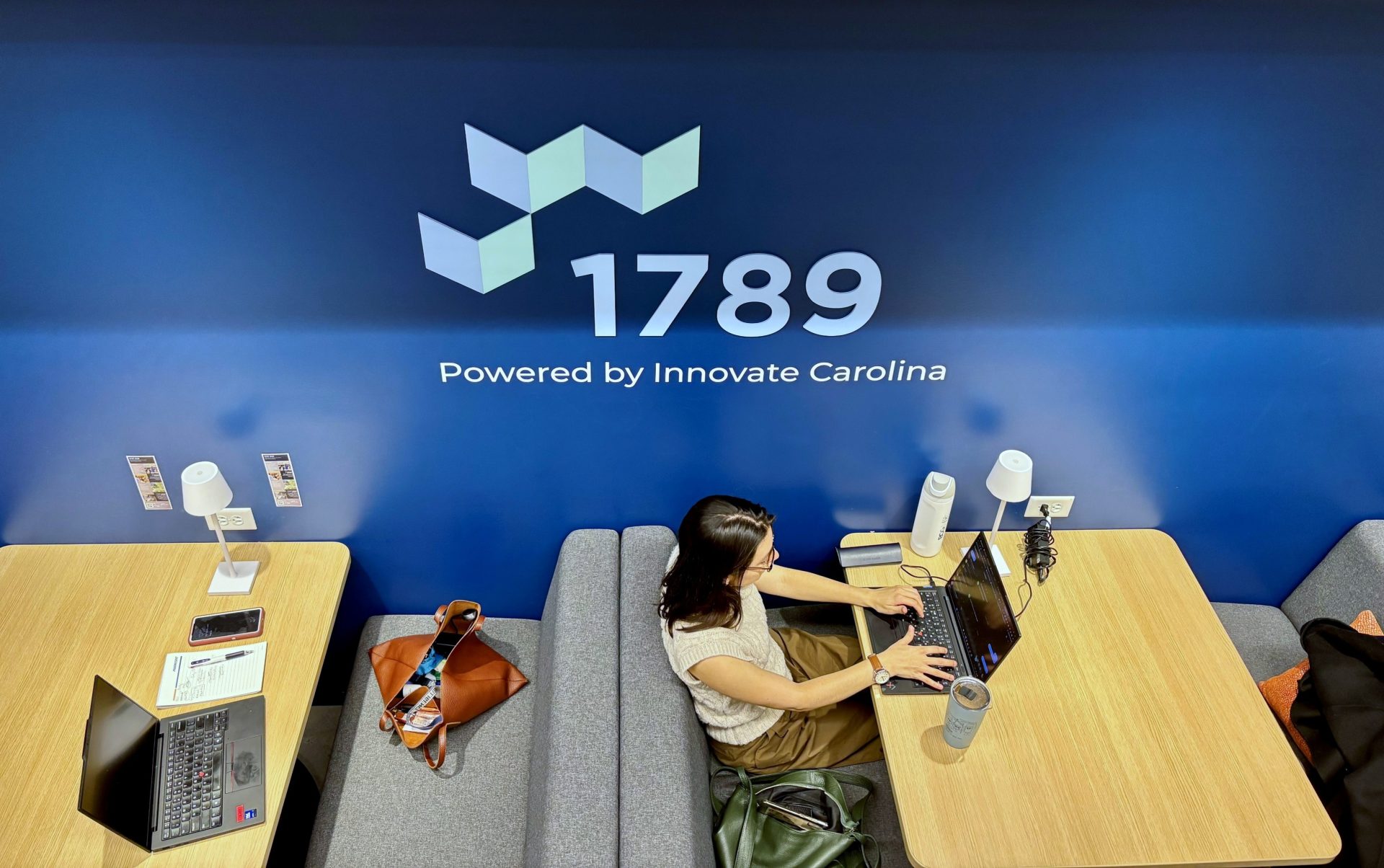
A low-cost, lab-free diagnostic device for cervical cancer. A data-driven digital marketplace that matches you with the perfect puppy to adopt. An AI-powered search engine that saves you hours of manually weeding through LinkedIn and the web for business contacts. What may sound like entirely disconnected concepts share a common tie: they are three of 18 student startups announced by Innovate Carolina as the latest round 1789 Student Venture Fund awardees.
The winning ventures received $27,000 in combined support during a highly competitive and active fall 2025 award cycle that included applications from 48 student entrepreneurial teams. The fund, which is managed by Innovate Carolina, provides early seed dollars to help Carolina students advance their earliest-stage ventures. Jim Kitchen, Professor of the Practice in Entrepreneurship at Kenan-Flagler Business School, established the fund in 2020. Proceeds from Kitchen’s Business 500 course — in which students launch businesses and generate revenue — fund the 1789 Student Venture Fund program. In spring 2025, the course reached a significant milestone of $1 million in all-time net profits earned by student venture teams. Having taught the course for 16 years, Kitchen aims to give students the chance to work in teams: developing business ventures, applying what they’ve learned in real-world settings and generating real revenue. The class also provides students with ways to give back: donating profits to the Make-A-Wish Foundation of Eastern North Carolina and the 1789 Student Venture Fund.


“Teaching this course is one of the great privileges of my career because I get to watch students discover what they’re capable of when they build something real together. Seeing student entrepreneurs generate meaningful revenue — and then reinvest those dollars into the next generation of student founders through the 1789 Student Venture Fund — creates a powerful cycle of entrepreneurial learning and impact.” said Kitchen. “It’s incredibly gratifying to know that what students create in the classroom not only transforms their own lives, but also fuels a broader community of students who are building new businesses in our local community and state.”
With seed dollars from the 1789 Student Venture Fund awarded each fall and spring semester, the program makes an immediate impact for student entrepreneurs. Selected student startups use the funding to support prototyping, marketing, software, travel and other avenues that help them move their products and services forward.
“We are grateful to Jim Kitchen and the students in his entrepreneurship course for their energy, ingenuity and the support they provide. By generating revenue in the classroom and channeling those dollars into the 1789 Student Venture Fund, his students are not only practicing entrepreneurship—they’re actively bolstering innovation across campus that has positive business-building effects beyond the University,” said Anise Robinson, Student Engagement Manager at Innovate Carolina. “For the student-founders who receive support from the fund, it means access to meaningful seed dollars and the practical tools they need to transform ideas into tangible businesses.”

Aryah Oztanir, a Carolina undergraduate student pursuing his bachelor’s degree from Kenan-Flagler Business School, says that his company ERA-0 gained quick early momentum. ERA-0 uses artificial intelligence (AI) to significantly streamline the effort it often takes people to find large numbers of verified business contacts and email addresses, reducing the time from days to just minutes. Within four days of posting about its platform on LinkedIn, the company fostered 7,000 connections between users and contacts in its database, helped users discover over 1,000 real companies, and validated over 10,000 emails. The 1789 Student Venture Fund will help Oztanir and the company overcome unexpected technical hurdles so that it can build on its early success. “Our servers have crashed multiple times in this period because of the unforeseen levels of traffic we are receiving,” he said. “We are in crucial need of funding to purchase stronger infrastructure
Graduate student Jordan Meier, who is enrolled in the UNC School of Education’s Master of Arts in Educational Innovation, Technology and Entrepreneurship program, is launching a company to support startup accelerator programs at small and midsize universities. His company will provide university accelerators with custom curricula, standardized marketing materials, and database solutions for tracking student engagement. “As I launch my accelerator consulting firm, customer discovery is a critical early step,” said Meier, who also works to help organize and manage accelerator programming at Launch Chapel Hill located at the Innovate Carolina Junction downtown. “The 1789 Student Venture Fund dollars I received will allow me to attend an industry conference where I’ll be able to meet, talk and learn from faculty and startup accelerator leaders at other universities to more fully understand their needs, further validate our business concept, and build connections with future clients and partners.”

As of fiscal year 2025 (FY25), Innovate Carolina had awarded $174,834 to 137 student startup teams through the fund (since 2021). Student startup teams receiving support had gone on to raise more than $2 million in funding—approximately 12 times more than the funding provided through the student venture fund. Of the 137 supported startup teams, 67 companies remained active during FY25, earning $7.9 million in revenue and employing 5,676 people. The latest round of 18 funded student ventures will add to this previously reported cumulative impact and includes the following startups:
 | UNC-CH