TIIP award program promotes stepping beyond traditional research methods by embracing creative, human-centered design to revolutionize public health interventions.
Starting her public health career in community outreach programs, Melissa Cox, Ph.D., has always had a focus on empowering community voices as a guiding principle to achieve health equity. After completing her master’s degree in public health, Melissa worked in a rural district in South Carolina where she ran a teen health project with a local school that provided leadership tools, health knowledge and professional development opportunities for students. Working directly with the local community inspired a shift in how Melissa thought about health access and led her to think about our intersecting identities and how that drives health, for better or worse.
Passionate about the intersection of adolescent health and community prevention, Melissa started her Ph.D. program at the University of North Carolina at Chapel Hill to explore adolescent substance use prevention. More than eight years later, she is now assistant professor at the Gillings School of Global Public Health, contributing to important research on population level impacts of alcohol use, and innovative, adolescent-led strategies to reducing alcohol related harms.
Wanting to work toward a solution to address youth and young adult alcohol harm reduction intervention, Melissa realized standard grant processes left little room for innovation. Fortunately, a colleague shared information about Innovate Carolina’s Design and Innovation for the Public Good team and it’s Translating Innovative Ideas for the Public Good Award, which supports innovative projects that embody Carolina’s mission to drive research, invention and innovation for public benefit. DIPG works on “wicked problems,” problems that are culturally and socially embedded, complex and pervasive, making them difficult to define and solve.


Melissa saw the TIIP award as an opportunity to address what she views as a “wicked problem” for young people today. Alcohol use is “… so deeply embedded in our social culture that it presents a unique challenge compared to other substances,” says Melissa. “We know earlier life formations have long-term impacts, and alcohol drives harm because of the wide scope of use and the negative consequences associated with it.”
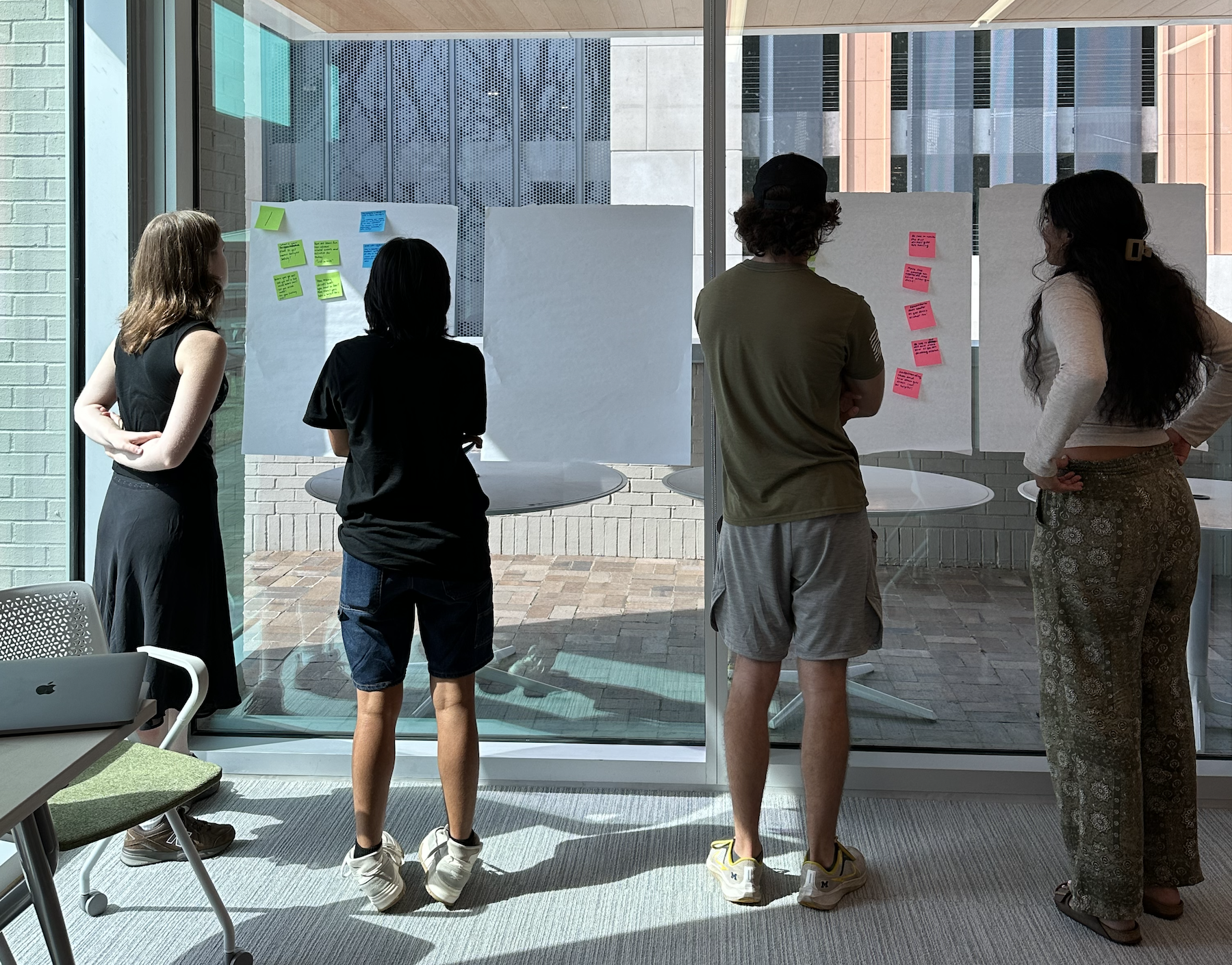
Melissa applied and ultimately received a TIIP award, which provided $51,000 in funding support for her project. She was one of four awardees and receiving the award was a critical next step to move beyond linear approaches to problem solving. In support of her project, the DIPG team designed and conducted a series of design thinking workshops with young people to gain their perspective and insights into what a meaningful alcohol harm reduction intervention could look like.
Led by Liz Chen, Ph.D., Innovate Carolina’s Design Thinking Lead, and Jacinta Bailey, Design Thinking and Innovation Fellow, the workshops with college-aged adults in the area aimed to drive the intervention process forward while remaining grounded in the voices, experiences, desires and stories of the young people at the center of the challenge.
“Innovate Carolina’s design thinking experts offered structure, a framework and a facilitation process to guide a more innovative approach,” says Melissa. “The DIPG team has a level of expertise, but also a level of approachability to meet investigators and projects where they are and guide the process. That’s such a gift to this university; I don’t have to become trained in design thinking. We have experts to work with us to facilitate this process.”
What surprised Melissa about the human-centered design approach was “how powerful creativity is at getting ideas flowing and harnessing that for intervention development.” The TIIP Award ultimately broadened what could be considered an outcome, informing a more rigorous mobile health intervention for youth alcohol use prevention. The highlight for Melissa and her research team was engaging with the people they were designing for. “We were able to connect with them, meet them where they are, hear about where they are, and learn from them.”
At its core, design thinking is about designing with the people your product aims to serve. For most traditional researchers, the notion of embracing ambiguity and iteration does not seem in line with most grant opportunities. The pressure to know the “right” answer often unintentionally stifles innovation. Melissa felt this throughout her engagement with the DIPG team. The process of design thinking incorporates creativity and artistic approaches to move beyond linear thinking and expand what is possible.
“I think anybody who’s trained in the sciences and goes through formal education in general is just more rooted in a linear process. And so, it takes a little bit of encouragement to break out of that,” says Melissa. “I think we got there with the students in the sessions, and when it happened you could feel the energy shift and ideas coming forward,” she says.
As a TIIP Award winner, Melissa saw firsthand the value creative problem-solving approaches like design thinking can offer to researchers. Acknowledging the hesitation many researchers hold when invited to design thinking workshops, her advice to colleagues on the fence about engaging with innovative problem-solving methods is to, “Just do it!”
“There’s no real risk… just gains to be made,” says Melissa. “The DIPG team thinks in really different ways and can add an entirely new perspective, allowing space to deeply think about the project outside of linear models. You go through this process, and you’re going to get ideas that you hadn’t conceptualized before that can move a lot of different types of science forward.”
TIIP Award 2025 Applications are now open.
 | UNC-CH