If you’ve ever sat down to solve a hard problem and realized halfway through that you were solving the wrong one, you already understand the value of what DIPG — Design and Innovation for the Public Good — does every day.
Innovate Carolina’s DIPG team offers a variety of human-centered design services: advising, coaching, and workshop facilitation. These services help people create ideas that make a real, positive impact on the communities they wish to serve. That work reaches two groups equally: University faculty, researchers, and staff strengthening a project or grant; and industry, civic, and nonprofit partners working through real-world problems of their own.
Recent clients include Angel Hsu of the Center for Climate Leadership, and Melissa Cox, and Oscar Flemming from the Gillings School of Global Public Health.
It’s a creative problem-solving approach that starts with the people a project is meant to serve — understanding their needs before committing time or money to a solution. It’s built around failing fast and iterating early to uncover the best ideas, rather than settling on a single fast solution that ends up being a mismatch after the fact.
“As we work with clients at Carolina and across industry and government, our focus on creating impact means innovating for the public good,” said Bill Romani, director of DIPG. “Our process emphasizes the human condition and co-creation so that we generate and test innovative ideas that all parties agree provide economic and societal benefit.”
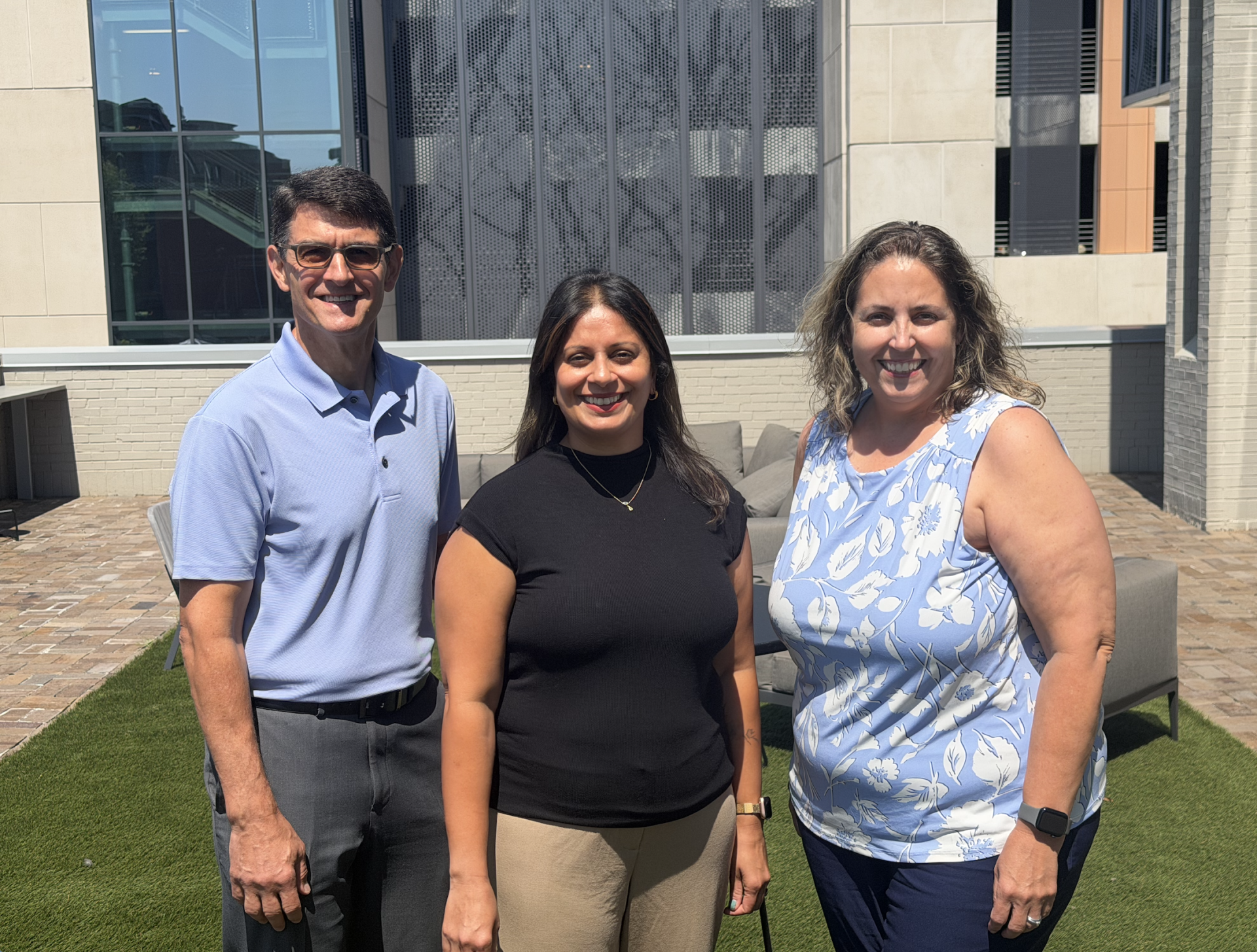
DIPG has increased its capability to serve clients through human-centered design services over the past several years. Two recent additions to the team — UNC-Chapel Hill alumnae Purvi Patel, PhD and Rozana Carducci, PhD — are helping expand what the team can offer next.
Patel has two decades of corporate experience, including 15 years in design thinking and innovation strategy, executive education at Stanford University, and leading workshops globally. Carducci brings 16 years of higher education faculty and leadership experience, including a research background in qualitative methods, organizational behavior, and human-centered design.
“I think the nice thing about the two of us is that we bring expertise from two very different sides, but we’re able to take a common methodology and apply it here,” Patel says. Rather than reinventing the wheel, both see their role as building on top of what DIPG has already established.
Testing an idea through human-centered design is a smaller, more deliberate step than something like a large-scale survey. It also protects against one of the most frustrating outcomes of a project timeline: getting most of the way through, only to discover the intended audience can’t actually use what was built. For research-focused clients, that same grounding often translates into stronger grant proposals, interventions, or community-based solutions, rooted in real conversations rather than assumptions.
Looking ahead, Carducci says the team wants to build on that foundation even further. “Our near-term vision is that we will continue to do our customized work, but we’re also hoping to offer and develop a menu of foundational workshops in human-centered design,” she says. “That’s something we really want to prioritize this year — to have things like strategy, foundations, analysis, or prototyping packaged and ready to go.”
Interested in learning how your team can put human-centered design to work? Explore DIPG’s design thinking and innovation services.
 | UNC-CH